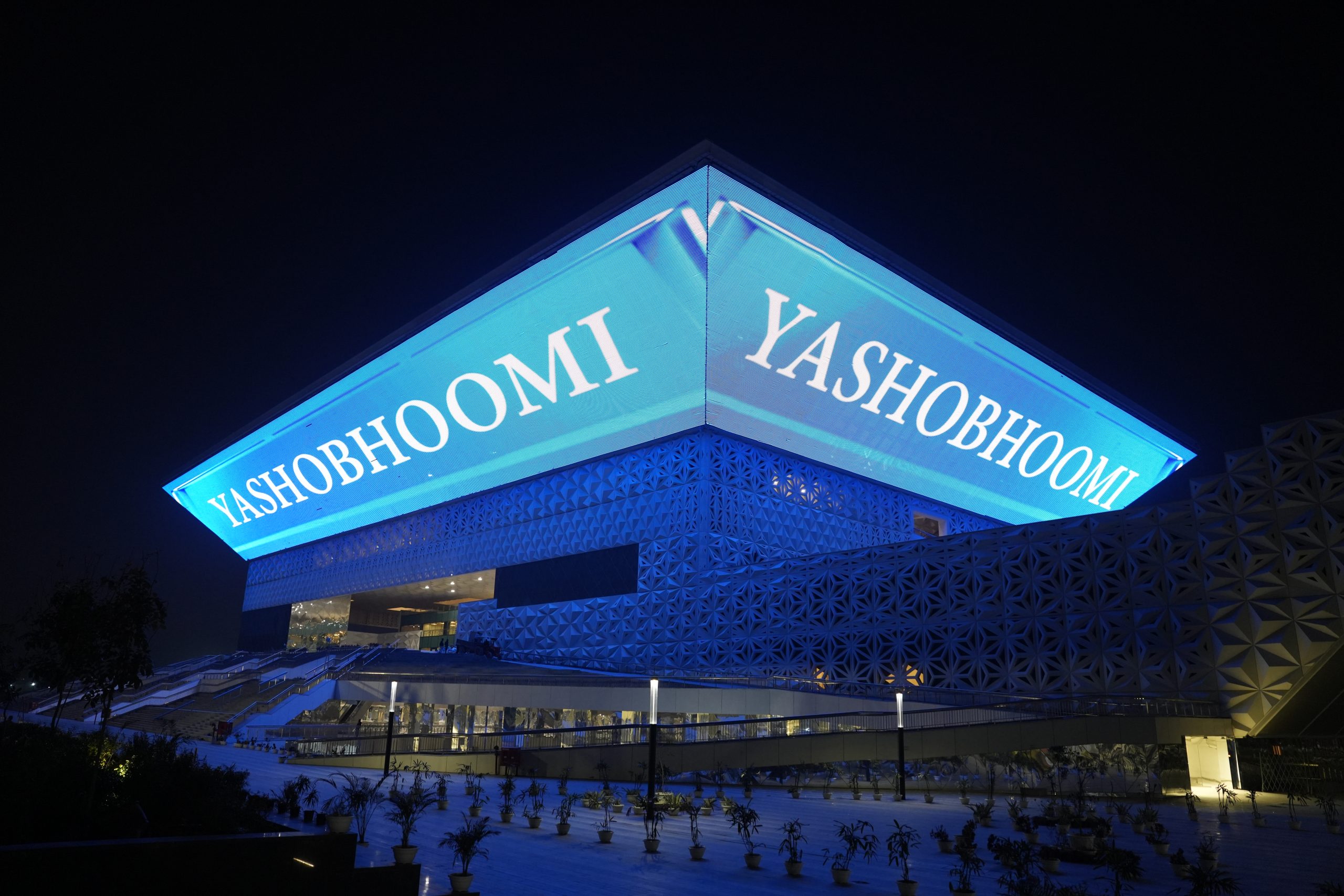
Yashobhoomi has positioned itself as India’s largest convention and exhibition ecosystem. As India positions itself as a serious contender in the global MICE (Meetings, Incentives, Conferences and Exhibitions) economy, infrastructure has begun to match ambition. At the centre of this shift stands Yashobhoomi (India International Convention and Expo Centre) — a venue conceived not merely as a convention complex, but as a statement of India’s intent to host the world at scale.
Over the past year, Yashobhoomi has begun to attract marquee exhibitions, global summits and high-profile cultural programming, signalling what many describe as its coming-of-age moment. But beyond architecture and event listings lies a more strategic question: Can India now compete with established global convention hubs in Singapore, Dubai and Frankfurt? And what does it take to build credibility in the big league of international exhibitions?
To understand how sales strategy, global positioning and infrastructure readiness are converging at this pivotal stage, Namrata Kohli speaks with Amit Aggarwal, Head – Exhibitions (Sales & Marketing), Yashobhoomi IICC
Yashobhoomi has positioned itself as India’s largest convention and exhibition ecosystem. What gap in India’s MICE infrastructure were you trying to solve — and how close are we to competing with Singapore or Dubai in scale and efficiency?
India has long been a high-growth market for trade and commerce, but our exhibition infrastructure historically lacked scale, modularity, and global-grade integration. Large international exhibitions require contiguous column-free halls, high load-bearing capacity, seamless freight access, combined with large scale convention facility, accommodation & hospitality integration — elements that were fragmented across Indian venues.
Yashobhoomi was conceptualized as first of its kind Integrated MICE district in ASIA that offers Large Exhibition Halls, Convention Centre, Hotels, Commercial Spaces within the same premises with proximity to the International Airport and direct connectivity with all modes of transportation — to create a unified ecosystem that matches global benchmarks in size, efficiency, design flexibility, accessibility and ease of use.
Large exhibition venues are often described as economic engines. From hospitality to logistics to aviation, what has been the measurable multiplier impact of Yashobhoomi on the Dwarka–West Delhi micro-market so far?
Exhibition infrastructure acts as a catalytic anchor. Since Yashobhoomi launch, the Dwarka–West Delhi belt has witnessed increased hotel inventory planning and new hospitality investments, growth in F&B, transport, and local service providers, higher occupancy levels during event cycles and strengthened airport-linked business travel.
Given its proximity to Indira Gandhi International Airport, international delegate inflow directly benefits aviation and allied sectors. Exhibitions create a ripple effect — each large-format show drives thousands of room nights, freight movements, and vendor engagements.
Over time, such venues redefine micro-markets — similar to how global exhibition districts evolved into commercial hotspots.
Are you seeing stronger traction from international exhibitions or domestic trade shows? And what sectors — defence, manufacturing, real estate, tech — are driving maximum bookings today?
Currently, domestic trade shows form the bulk of recurring volume, primarily because India’s internal market is expanding rapidly. However, international participation — both exhibitors and buyers — is steadily increasing.
High-performing sectors include manufacturing & industrial engineering, defence & aerospace, renewable energy, technology & electronics, real estate & infrastructure. India’s positioning as a manufacturing and supply-chain alternative has significantly boosted B2B exhibition demand. International organisers are increasingly viewing India not just as a consumer market, but as a sourcing and production hub.
With proximity to IGI Airport and metro connectivity, how critical is last-mile infrastructure in attracting global organisers? What still needs strengthening for India to become a true exhibition hub?
Connectivity is one of the most important aspects of any International Event planning. Being minutes from IGI Airport and integrated with Delhi Metro gives Yashobhoomi a competitive edge. Yashobhoomi is the only venue in India that offers such accessibility to the attendees, and they can reach the venue from the airport by METRO within 10 minutes.
The opening of direct tunnel from IGI Airport to Yashobhoomi has further reduced the travel time for delegates and participants to mere 15-20 minutes. This allows the attendees to spend most of their time at the event and getting opportunity to meet most of the participants and visit the event. However, becoming a global exhibition hub requires faster customs and freight clearances, standardized international service protocols, stronger city-level event facilitation mechanisms and more integrated hotel clusters within walking distance.
Singapore and Dubai succeed not just because of infrastructure, but because of execution speed and ease of doing business. That’s the next leap India must take. The convention bureaus and tourism department of GOI needs to pitch in for promoting India as MICE destination and offering incentives to the international attendees.
Post-pandemic, digital and hybrid events surged. Are physical exhibitions back at full strength, or has the format permanently evolved? What does the exhibition model of 2030 look like?
Physical exhibitions are not only back — in many sectors, but they are also stronger than pre-pandemic levels. Human interaction, product demonstration, and trust-building cannot be fully digitized. That said, the model has evolved. The exhibition of 2030 will likely be:
- Hybrid by default (physical + digital lead capture + AI matchmaking)
- Data-driven with measurable ROI dashboards
- Sustainability-focused with green building norms
- Experience-centric rather than stall-centric
The future lies in intelligent ecosystems — where infrastructure, technology, and commerce intersect seamlessly. Yashobhoomi vision is to position India as a strategic node in the global exhibition circuit — not just a venue, but a gateway. With signing of multiple FTAs with different countries in present the Exhibitions and Conventions will further strengthen B2B Interactions in coming days and grow multifold.