
In a farmhouse on the outskirts of Delhi, music does not play — it just hangs all around you. There are no visible speakers, no wires, no blinking lights. Just pure sound. It travels through the room, settles into corners, fills the air without announcing where it comes from. This is how it has been designed.
India’s luxury market is evolving. Homes are getting larger, more customised, more experience-driven. And within that, sound is finding its place. Not as an add-on, but as a defining element. Unlike marble or furniture, you cannot see it. But you can feel it. Because, in the end, the most expensive sound system is not the one that impresses a room full of people, it the one that makes you stop and listen.
Not surprisingly, across India’s luxury homes — from South Delhi bungalows to Mumbai’s sea-facing apartments — sound is quietly becoming the next big spend. Not in the form of gadgets, but as part of architecture itself. Audio is no longer bought. It is built in.
And it is expensive. The most sophisticated systems today can cost anywhere between Rs 10 lakh to a few crore. In many cases, it costs more than a car, almost as much as a home itself. But this is not about louder music. It is about better sound.
How is sound becoming part of luxury home design?
There was a time when a sound system sat in the corner of a room – visible, functional, usually oversized. That idea is fading.
Today, in high-end homes, sound is planned the way lighting or air-conditioning is. Speakers are concealed. Walls are treated. Rooms are calibrated. Floors are engineered to absorb vibration. What you see is minimal. What you hear is precise.
“In the modern home, luxury is no longer a loud statement — it is a quiet presence,” says Monicaa Sambharya, managing director, EIS Domotics. “It’s not about bass or volume. It’s about being able to hear detail — the breath in a voice, the texture of an instrument. It’s a live performance, but private.”
This shift from device to environment is what defines the current moment in luxury audio.
How much do premium sound systems cost in India?
At the top end of the market, names like Bang & Olufsen, Bowers & Wilkins, Devialet, McIntosh and Focal dominate. Entry-level premium systems start at around Rs 3 lakh–Rs 5 lakh, but that number can climb faster than a simian shimmying up a tree.
A multi-room system — where sound follows you from one space to another — can come for Rs 10 lakh–Rs 30 lakh. A fully customised listening room, designed for optimal acoustics, can cost a cool Rs 1 crore.
“Buyers today are not asking how loud a system can go,” says Sahil Arora, Founder, SoundTrails. “They’re asking how clearly it can reproduce sound.”
He points to brands like Marantz, Sonus Faber, and KEF as favourites among serious buyers. Some models, like the Sonus Faber Stradivari, cross Rs 40 lakh. Amplifiers such as the Marantz AMP 10 are standard in high-end home theatre setups.
But the real cost, Arora says, lies beyond the equipment. “A large part of what you’re paying for is engineering — how the sound behaves in a room, how materials respond, and how the system is tuned.”
How are design and technology shaping luxury audio systems?
One of the more interesting shifts in this category is the overlap between design and technology.
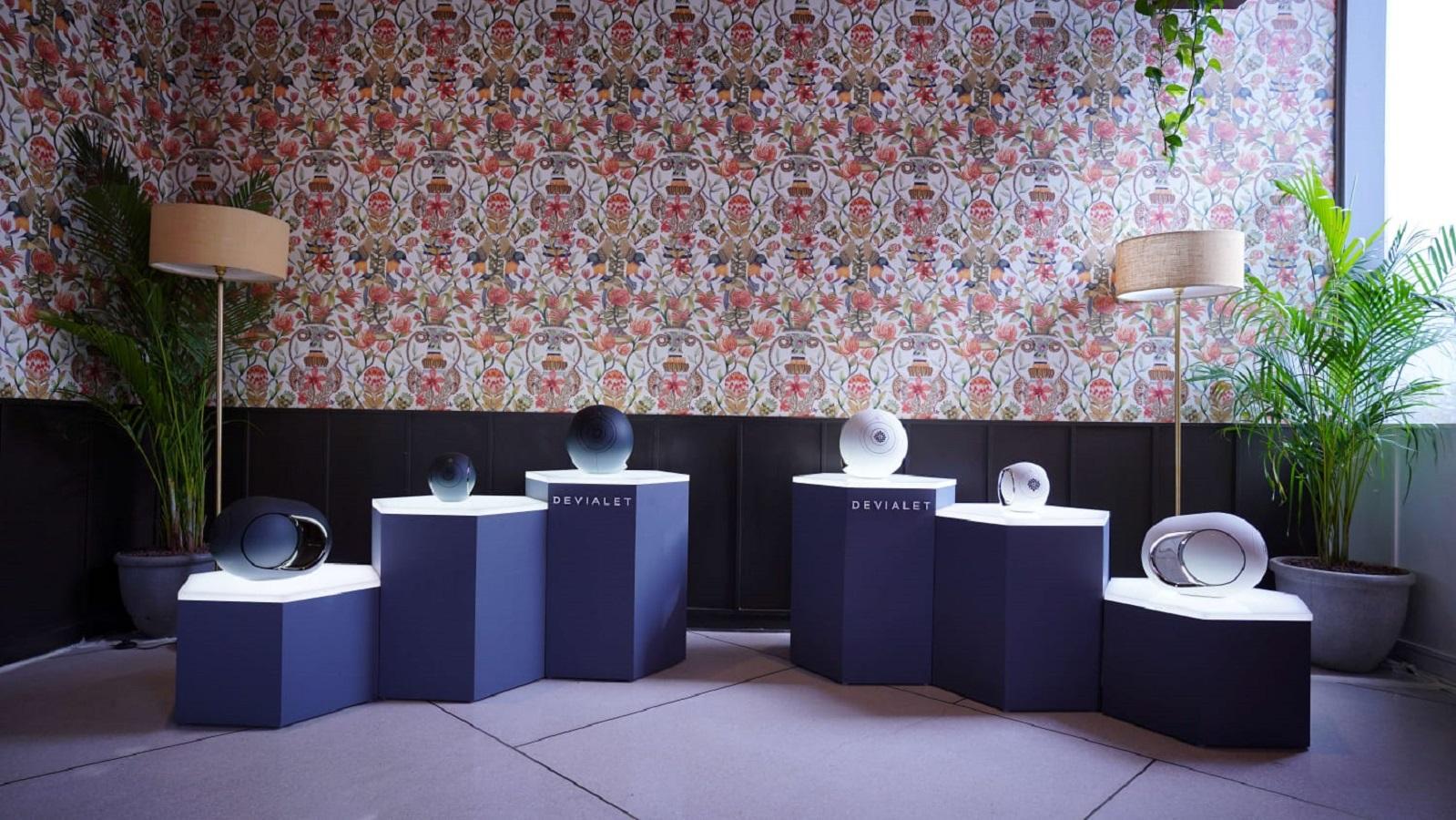
Take Devialet. The French brand has built a following in India for its Phantom speakers: compact, sculptural units that deliver high output without dominating a room. Priced between Rs 2 lakh and Rs 4.8 lakh, they are often seen as an entry point into high-end audio.
Similarly, Sonus Faber — founded in Italy — has positioned itself closer to craftsmanship than consumer electronics. Its speakers are often compared to musical instruments, built with the same attention to material and detail. Prices range from around Rs 4.6 lakh to nearly Rs 1.7 crore for limited-edition pieces.
“If a speaker were a musical instrument, it would be Sonus Faber,” says Sambharya, who has visited the brand’s manufacturing facility. “It’s not mass production. It’s closer to making violins.”
The point is clear: in this segment, sound systems are as much about how they look — and how they fit into a space — as how they perform.
Why are buyers opting for customised home audio setups?
For many buyers, off-the-shelf is no longer enough. Delhi-based AV Shack, which specialises in high-end installations, is seeing growing demand for customised solutions. “Clients want systems that work with the design of their home,” says Pratham Arora. “It has to sound good, but it also has to look right.”
That often means building systems into walls, ceilings and furniture, effectively making them invisible. It also means working closely with architects and interior designers. The result is a shift from product to project.
What actually constitutes good ‘sound’?
Strip away the price tags and brand names, and the question becomes simpler: what does good sound actually mean?
The answer, interestingly, is not about what you hear, but what you don’t. “The hallmark of a premium system is the absence of distortion,” says Sambharya. “Music should emerge from silence.”
Martin K, general manager for APAC at Devialet, explains it in more technical terms. Sound, he says, exists as a continuous wave. A good system reproduces that wave as accurately as possible. But most everyday systems don’t.
To make audio files smaller and easier to transmit — over Bluetooth, for instance — sound is compressed. The wave is flattened, losing key details in the process.
“What you hear becomes flatter,” he says. “You lose nuance, but you don’t always realise it until you compare.”
That comparison is often what draws buyers into the premium segment.
How should buyers choose the right premium sound system?
For those entering this category, the starting point is not budget but behaviour. How do you listen? What do you listen to? Where will you place the system? A wireless speaker may be enough for casual use. But serious listening requires a more considered setup: source, amplifier, speakers, and most importantly, the room.
Acoustics matter more than most people realise. Hard surfaces reflect sound. Poor placement distorts it. Even a high-end system can underperform in the wrong environment. This is why many luxury buyers invest as much in calibration and installation as they do in equipment.
And then there is the simplest rule: listen before you buy. What works in one room or for one person may not work for another.