Just two-and-a-half hours from Delhi, a palace in Karnal is rewriting the rules of luxury hospitality. Behind its grand arches, sprawling courtyards and royal weddings lies an extraordinary story of ambition, aesthetics and an enduring partnership.
What does a soldier dream of when he visits a palace? Perhaps history, grandeur or the lives of kings. But when Colonel Manbeer Singh Sandhu walked into Jaipur’s Rambagh Palace in 1977, he came away with something rather unusual: the desire to build a palace hotel of his own.
It was an improbable ambition for an Army officer whose professional life had little to do with hospitality. But some dreams have a way of refusing to retire.
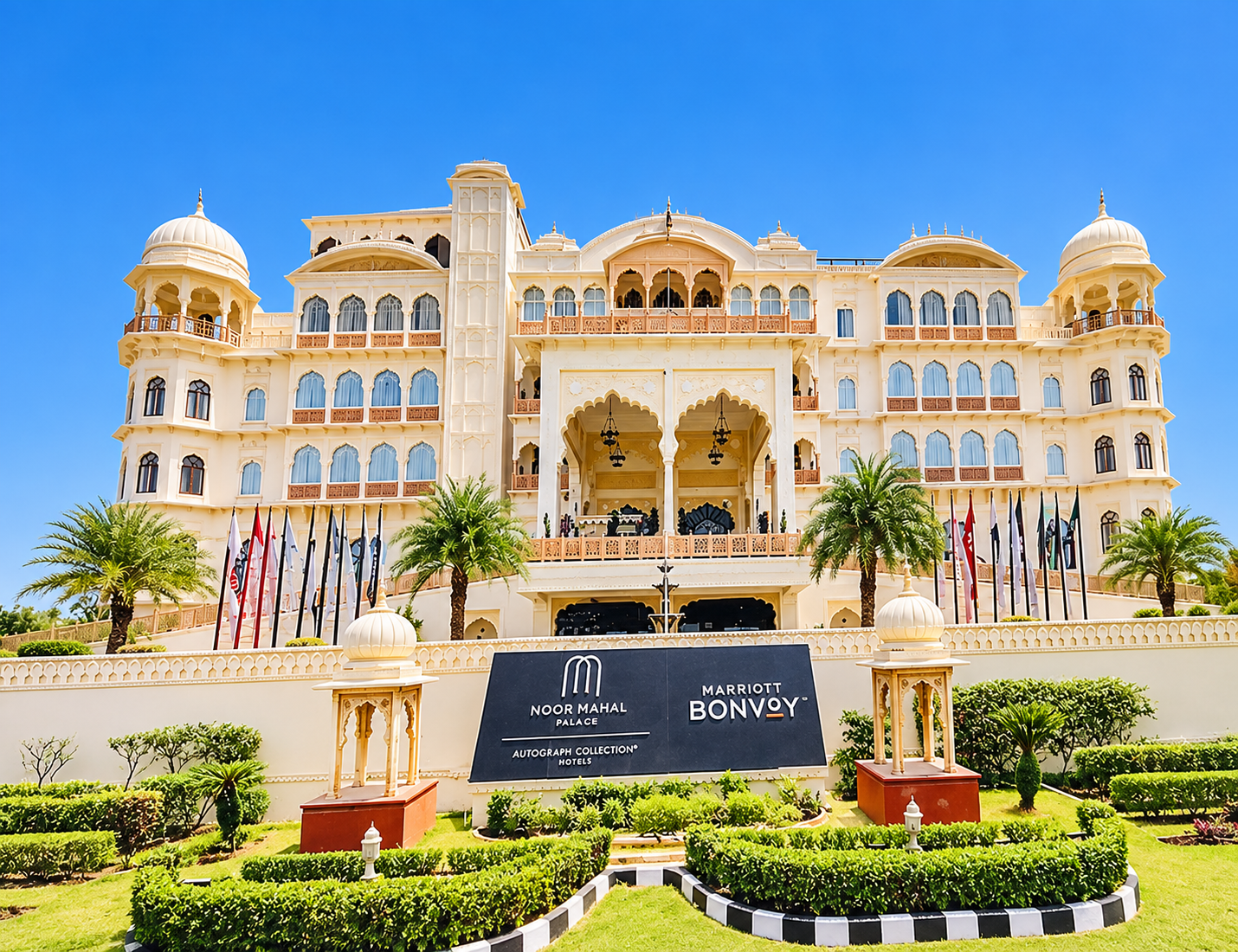
Nearly five decades later, that dream stands in Karnal, Haryana, in the form of Noor Mahal, a sprawling palace-style hotel that brings together the architectural grandeur of Rajasthan, Mughal influences, Punjabi exuberance and contemporary luxury.
And here’s the interesting part. You don’t have to travel to Rajasthan to experience it.
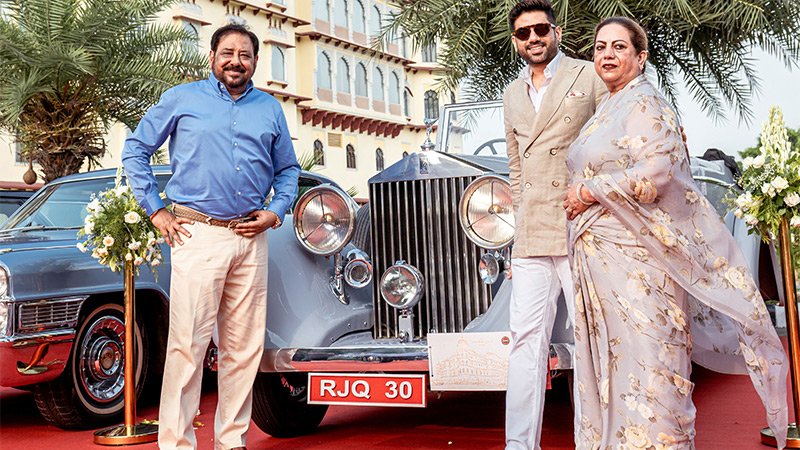
Owners – Colonel Manbeer Sandhu, CMD at Noor Mahal Group, Binny Choudhary, MD at Noor Mahal Group and Roop Partap Choudhary, ED at Noor Mahal Group
From the Army to Architecture
Colonel Sandhu spent 25 years serving in the Indian Army, including three consecutive postings in Rajasthan. It was here that he developed his fascination with palace hotels.
“The first five-star hotel I ever visited was Rambagh in Jaipur in 1977,” he recalls. The experience stayed with him. “I just said aloud one day, Hey Bhagwan, mere paas bhi aisa hotel hona chahiye.”
He laughs at the memory. “I think God was in the right mood, so he listened to my prayers.”
But divine intervention, as any entrepreneur will tell you, still requires a business plan.
After taking premature retirement from the Army, Sandhu entered hospitality with Hotel Jewels, a smaller property in downtown Karnal. The venture proved successful, giving him both the confidence and the financial foundation to pursue his larger ambition.
His military background, he believes, shaped his approach to business. Quality, discipline and transparency were non-negotiable.
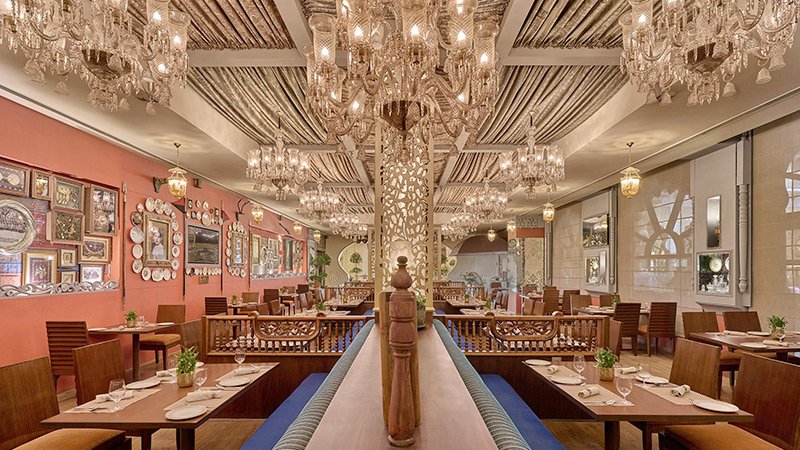
Colonel Saab
“I raised the bar for prices even 25 years ago. I made it double,” he recalls, explaining that customers were willing to pay for a superior experience.
Over time, Sandhu became actively involved in hospitality industry associations, eventually serving as president of the Federation of Hotel and Restaurant Associations of India (FHRAI). Despite having no formal hospitality education, he found himself learning from some of the industry’s biggest names, including Rai Bahadur M.S. Oberoi, P.R.S. Oberoi and senior leaders associated with the Taj, Leela and ITC hotel groups.
He remembers making notes after meetings, studying everything from architecture to service standards. “I would write down what I liked about a particular hotel and what I could learn from it.”
The soldier had become a student of hospitality. And he was preparing for his second innings.
A Palace Without a Royal Past
India has no shortage of heritage hotels. Rajasthan, in particular, has mastered the art of converting former royal residences into luxury hospitality destinations.
Noor Mahal takes a different route. It is not an inherited palace converted into a hotel. It is a palace imagined and built in modern times, drawing inspiration from centuries of Indian architecture.
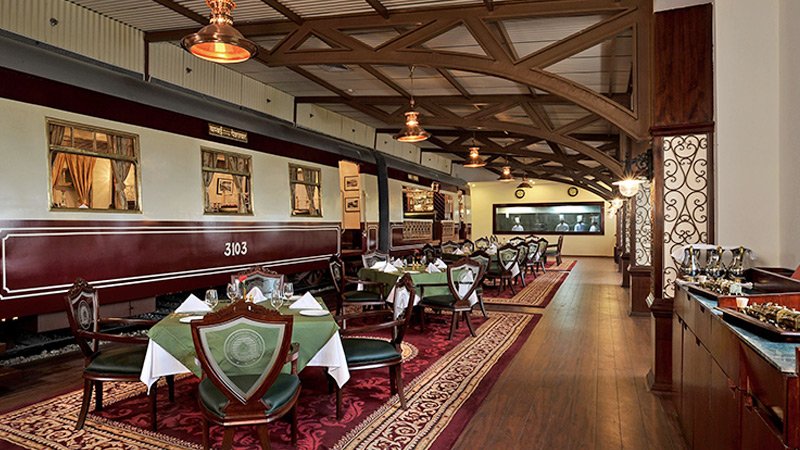
Frontier Mail
Sandhu believes this distinction is important. “From Delhi to Lahore, there is no palace hotel,” he says, describing the gap he perceived in the northern hospitality market when developing the property.
His ambition was not merely to recreate Rajasthan in Haryana. “I didn’t want to highlight Punjab. I wanted to highlight my India. I have served the Tricolour for 25 years. I don’t belong to Haryana or Punjab. I belong to India.”
That philosophy is visible throughout the property. Mughal-style arches coexist with Rajasthani decorative traditions, Sikh and Punjabi influences, colonial touches and contemporary design.
Sandhu credits heritage architect Nimish Patel with translating his vision into built form. Patel, who also worked on celebrated luxury hospitality projects, brought an understanding of traditional Indian architectural vocabulary.
But the hotel’s personality extends beyond its architecture. There are stories in its corridors, decorative details, ceilings, courtyards and themed spaces. The Frontier Mail-inspired setting, for instance, recalls an era when railway travel was synonymous with elegance and adventure. This is not minimalism. And it makes no apology for that.
The Woman Behind the Details
If Colonel Sandhu provided the grand vision, his wife, Binny Choudhary, helped give Noor Mahal its distinctive aesthetic personality. Her approach to design is unapologetically Indian, generous and richly detailed.
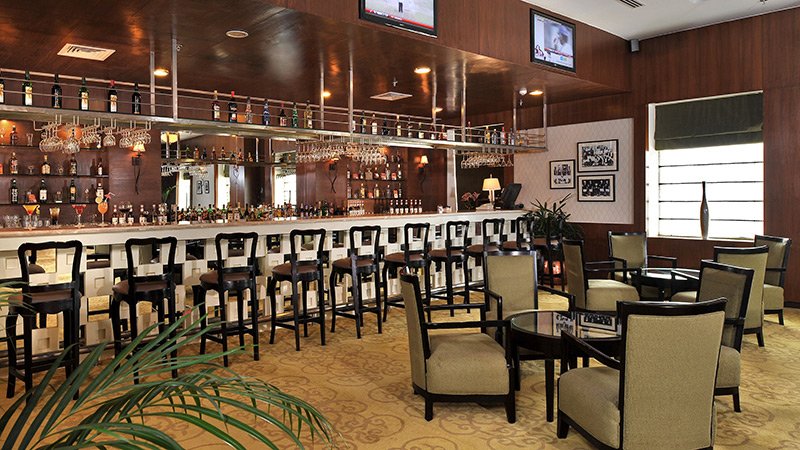
Polo Bar
“We wanted the architecture to look rich,” she explains. “But inside the rooms, you will find that richness along with all the modern amenities.” That balance matters. Even the bed is generously oversized. After all, there is little point in feeling like royalty if you cannot sleep like it. Choudhary is particularly conscious of avoiding the excesses sometimes associated with heritage-style hotels, where ornate furniture can become more impressive to look at than pleasant to use.
“We didn’t want to go overboard,” she says. The attention extends to seemingly ordinary objects. Glasses, plates, candle stands and furnishings are often larger than standard sizes, while several decorative pieces are specially commissioned.
“You don’t get everything in the market. Certain things have to be made to order, according to our designs.” Her explanation for this preference is delightfully simple. “Everything is big. Big hearts. This is Punjab.” And perhaps that is the essence of Noor Mahal. It is grand without trying to be restrained, rooted in tradition without sacrificing comfort.
Sandhu readily acknowledges his wife’s contribution. “She has an extraordinary sense of aesthetics, colours and interiors,” he says. Their partnership, he suggests, has been central to the property’s evolution. It is a rather charming reminder that behind some of the grandest hospitality ventures are often very personal stories.
The Big Fat Indian Wedding Finds a New Address
If architecture gives Noor Mahal its identity, weddings have become one of its strongest commercial propositions. For decades, Jaipur, Udaipur and Jodhpur have dominated the imagination of families seeking royal destination weddings.
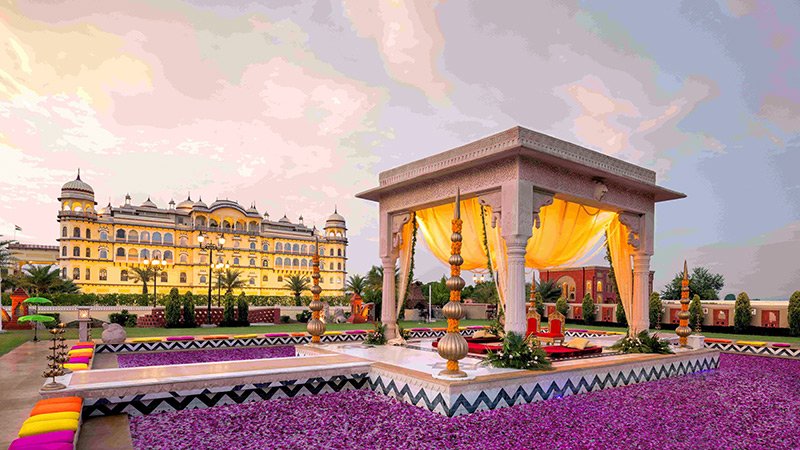
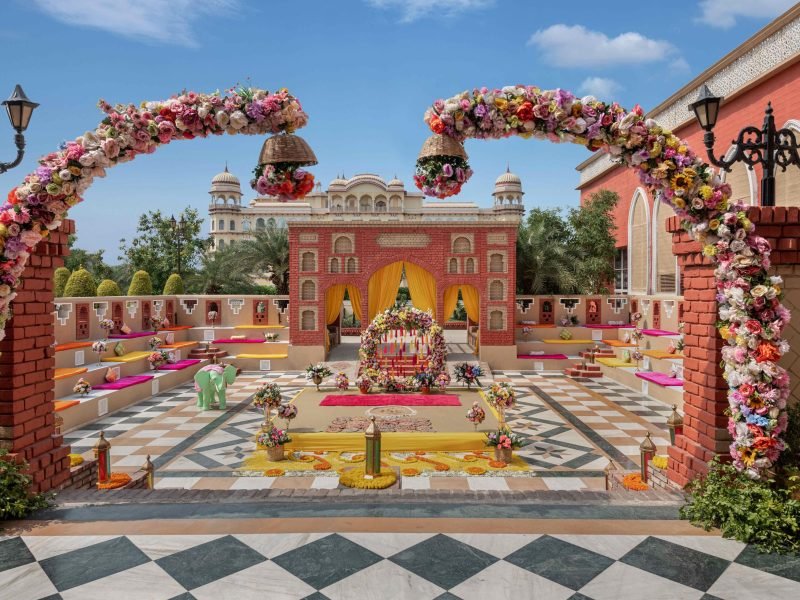
Hazuri Bagh at Noor Mahal Delhi NCR Karnal
But why travel hundreds of kilometres when a palace experience is available a few hours from Delhi? Noor Mahal is benefiting from precisely this proposition.
According to Binny Choudhary, the property hosts at least 100 weddings annually, ranging from residential destination celebrations to larger events attended by local and regional guests. The clientele extends well beyond Haryana. “We get people from Delhi NCR, Punjab, Rajasthan, Canada, the US, the UK and South Africa,” she says.
The property offers 19 event venues, allowing families to organise different wedding functions in distinctly different settings. A mehendi might unfold in a garden, a sangeet beside the pool, a wedding ceremony in a courtyard and a reception in a grand banquet hall. For families planning elaborate celebrations, this variety has considerable appeal.
Mahesh Singh Jasrotia, General Manager, Noor Mahal, believes today’s wedding customers increasingly seek experiences rather than conventional hotel facilities.
“People don’t want cookie-cutter hotels,” he says. “If you live in a high-rise in Delhi or Mumbai, why would you want to celebrate your wedding in another high-rise? You want to come to a palace, with green lawns and different venues.”
The economics are equally interesting. Jasrotia describes families arriving with wedding budgets of around ₹2 crore, expecting the hotel to accommodate a succession of celebrations, from pre-wedding photography and mehendi to the baraat and reception.
Even a dedicated four-hour pre-wedding photoshoot at the property is priced at ₹1 lakh plus taxes. And what do families want from a luxury wedding? Increasingly, convenience. “They just have to dress up and come and rest all is taken care of by us,” Jasrotia says apart from the fact that “They have to foot the bills!”
Bigger Venues, Smaller Guest Lists
Interestingly, the scale of the Indian wedding is also changing. Choudhary recalls a time when weddings with more than 1,000 guests were common. Today, she observes, many families are choosing gatherings of approximately 350–500 guests, although larger celebrations continue.
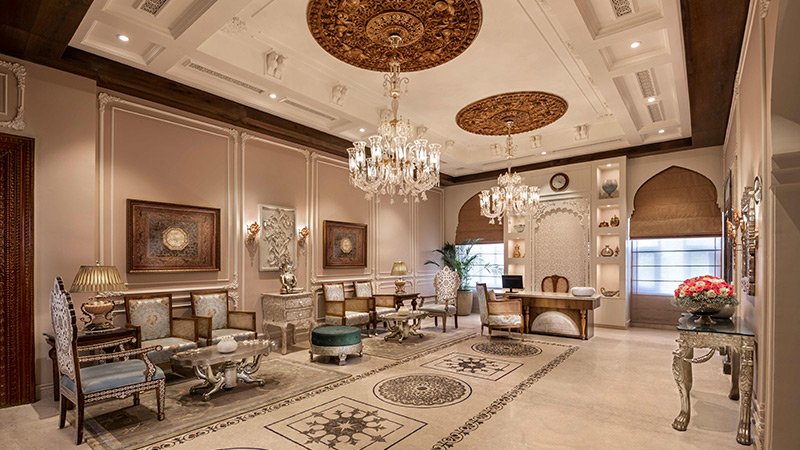
The Spa at Noor Mahal Delhi NCR Karnal
The number of functions, however, remains substantial. From roka ceremonies and pre-wedding shoots to mehendi, sangeet, weddings and receptions, the modern Indian wedding can stretch across several days. And expectations are becoming more international.
While Indian cuisine remains essential, families increasingly request Japanese, Burmese, Vietnamese and other global cuisines. For a hotel, that means delivering not just grandeur but flexibility.
Weather is another practical consideration. Open-air weddings may look spectacular in photographs, but unexpected rain or thunderstorms can disrupt the best-laid plans. Choudhary says the property’s outdoor venues have nearby indoor banquet spaces, providing alternatives when the weather turns.
It is an example of how the romance of a palace wedding must ultimately be supported by serious operational planning.
The Luxury of Being Different
Noor Mahal’s association with Marriott International’s Autograph Collection represents another chapter in its positioning. Jasrotia explains that the collection celebrates individual hotels with distinctive identities rather than properties built around a standardised design template.
The philosophy resonates with Noor Mahal’s approach. Instead of recreating the same luxury hotel experience found in metropolitan cities, the property seeks to offer something memorable and rooted in place.
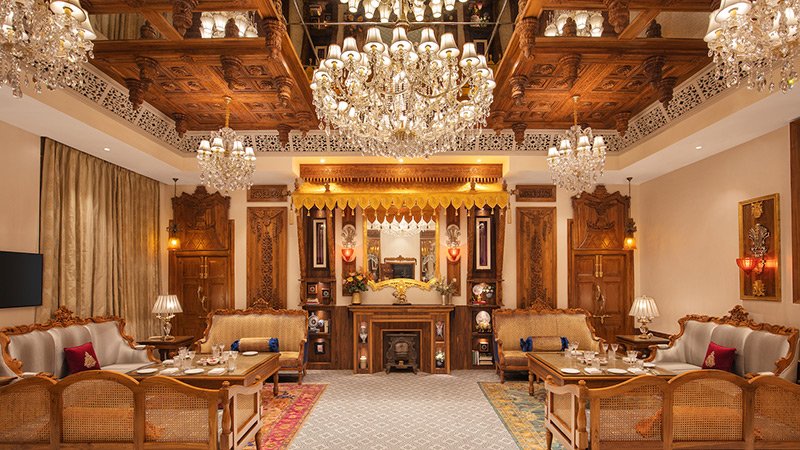
Lounge
For Sandhu, the challenge is to keep evolving. He speaks of continuous investment in maintenance, upgrading facilities and introducing new experiences.
“We have to compete with ourselves,” he says. It is an interesting philosophy from a man who spent much of his professional life in an institution built around discipline and constant improvement.
Beyond Weddings: The Rise of the Palace Staycation
Weddings may be a major attraction, but Noor Mahal is also positioning itself as a leisure destination for travellers from Delhi NCR and neighbouring cities. Its proximity to the capital makes it accessible for weekend getaways, family celebrations and short luxury breaks.
Choudhary says visitors also arrive from Patiala, Chandigarh and Yamunanagar for day outings, lunches and social gatherings. The appeal is straightforward: a change of setting without the inconvenience of a long journey.
For travellers accustomed to urban hotels, the experience of walking through palace-style courtyards, landscaped gardens and richly decorated interiors offers a different kind of escape. It also reflects a wider shift in Indian hospitality.
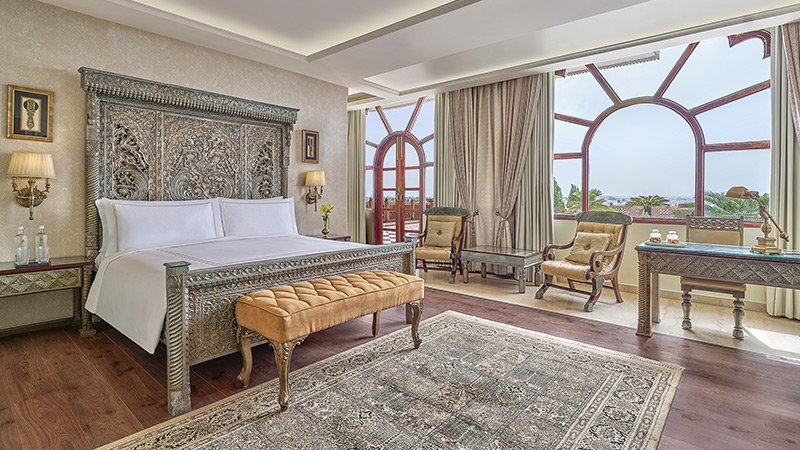
Heritage-Suite
Luxury is increasingly being defined not simply by international branding, expensive furnishings or the number of stars attached to a hotel, but by character, storytelling and a sense of place. A property need not be centuries old to offer a compelling heritage-inspired experience. But it must have a story worth telling. And Noor Mahal certainly has one.
Sometimes, the destination is not what makes a palace special. It takes one man’s dream to put a destination on the map.