
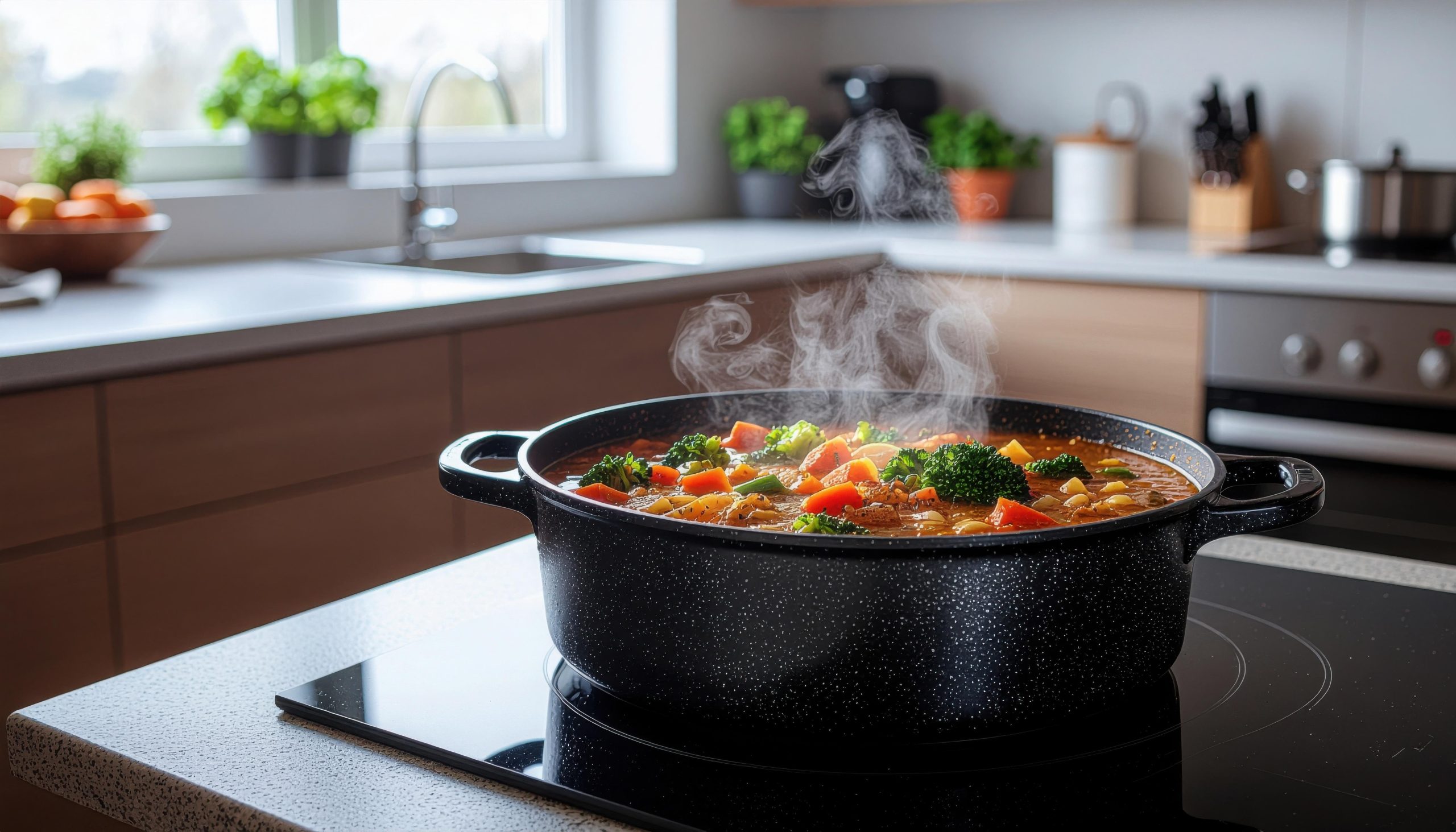
For generations, however, cooking in India has been defined by flame—gas stoves, open burners, and the instinctive control of heat through sight and sound. Today, that is increasingly being replaced by something far more precise, efficient and, in many ways, invisible: induction.
The conflict in West Asia has upended kitchen routines across the country, thanks to a shortage of liquefied petroleum gas (LPG) that is a staple of cooking methods in most households. Since most of India’s LPG is sourced from West Asian nations, the virtual closure of the Strait of Hormuz has severely hit supply to India’ oil marketing companies. And as LPG cylinders become a scarce resource, retailers are reporting a surge in sales of electric induction stoves, along with other electricity-powered kitchen appliances. A recent survey reported that nearly 23 per cent of Indian households have taken home an induction stove-top in March so far.
Why are induction stoves gaining popularity in India?
Induction cooking works on electromagnetic energy rather than direct heat. The result is faster cooking, lower energy loss, and a significantly safer cooking surface. In a country where multitasking kitchens are the norm, this matters. With LPG availability under a cloud, as evidenced by long lines at distribution outlets, induction is steadily moving from backup to primary appliance across many Indian households.
“Over the last week, sales of induction cooktops have increased 25 times, while rice cookers and electric pressure cookers have increased 5x and 15x, respectively, on Amazon.in. Customers have also been using Amazon Now to get similar products delivered within minutes across parts of Delhi-NCR, Mumbai and Bengaluru,” an Amazon India spokesperson said.
Yet, as chef Harpal Singh Sokhi points out, the hesitation to switch has its roots in a deeply cultural instinct. “Indian cooking has always been associated with fire. From the earliest days, cooking began on open flames — grilling, roasting — so our relationship with food is rooted in fire,” he says. However, he adds that the perception that induction cannot handle tadka, frying or slow cooking is largely a myth. “I’ve used large electrical cooking formats, and they work very well,” he says.
The real issue, he points out, is a combination of familiarity and wattage. Most home users opt for lower-wattage induction units, which consumer less power but can slow down cooking. “For a family of four, you need a higher-powered induction. The lower the power, the longer it takes,” he explains.
In other words, the limitation is not the technology — it is how we choose and use it.
What common mistakes do buyers make while choosing induction cooktops?
Despite the growing popularity of induction, many purchases go wrong for simple reasons. The most common mistake is choosing a low-wattage cooktop, assuming all models perform similarly. In reality, power directly impacts cooking speed and efficiency. Another oversight is ignoring voltage compatibility, which can lead to frequent breakdowns. Consumers also tend to ignore preset menu options on the machine, many of which go unused. What matters more is manual control and responsiveness.
Equally critical is cookware. Induction requires specialised magnetic utensils, something many first-time buyers ignore or forget about. Finally, buying purely on price often leads to disappointment. Cheaper units may look similar but compromise on coil quality, leading to uneven heating and shorter lifespans.
Premium vs practical: Which induction cooktop should you choose?
In the Indian market, brands like Philips and Prestige dominate the segment, offering reliable models with presets for Indian cooking, and robust performance. These work well for everyday use. At the higher end, built-in induction hobs from brands such as Bosch or other European manufacturers are increasingly finding a place in luxury modular kitchens. These are less about portability and more about integrated kitchen design, often paired with modular layouts and premium finishes.
The choice of an induction stove, though, boils down to use. Built-in induction cooktops are far more expensive than portable ones, which cost anywhere between Rs 2,000–Rs 8,000. At the other end of the price spectrum, built-in ranges may go into lakhs of rupees, driven by modular integration, multiple zones, premium materials, and advanced features.
For daily cooking, however, a portable, high-wattage unit is sufficient. Take the case of premium products such as those available with BSH Home Appliances – the parent company for brands like Bosch, Siemens, and Gaggenau. At BSH, the Siemens model (Rs 1.41 lakh–Rs 4.8 lakh) focus on smart, tech-led cooking, Bosch (Rs 95,000–Rs 3.6 lakh) blends performance with features like integrated ventilation and sensors, while Gaggenau (Rs 4.5–Rs 11 lakh) sits at the ultra-luxury end with full-surface induction and chef-grade precision.
According to Dinesh Kumar, founder of Ramesh Enterprises, a showroom of home appliances in Saket in South Delhi, “Entry-level models from brands like Prestige and Lifelong, priced around Rs 1,500 to Rs 2,000, cater to basic usage. Mid-range options from Philips and Havells, typically between Rs 2,500 and Rs 4,000, offer better build quality and preset menus, and are currently seeing the highest demand. Premium models from Bosch, focus on precision, durability, and advanced safety features. Overall, there is a clear shift towards mid-range and premium products as consumers prioritise reliability and everyday convenience.”
The dos and don’ts of induction cooking
“Induction cooktops offer faster, energy-efficient, and safer cooking, but require the right usage practices,” says Kumar. “Consumers should use flat-bottomed, induction-compatible cookware, as this directly affects performance. Using appropriate power levels or preset menus is important, especially for Indian cooking methods like tadka or slow cooking. Regular cleaning and proper ventilation help maintain the appliance’s lifespan.”
Using incompatible utensils such as aluminium or glass without an induction base can lead to poor results. Dragging cookware across the surface, blocking vents, or running the cooktop continuously for long durations on entry-level models should be avoided to prevent damage or overheating, he advises.
When nutrition meets induction
As more Indian households experiment with induction cooking, the conversation is shifting from convenience to nutrition and everyday usability. From a nutrition standpoint, induction offers a subtle advantage. Faster cooking times help retain nutrients, particularly in vegetables, says Aishwarya Bhatnagar, co-founder of Better Nutrition, a biofortified food brand focused on improving everyday nutrition. But she cautions that nutrition ultimately depends more on ingredient quality and cooking methods than the appliance itself.
For consumers, the shift is less about changing cuisine and more about adapting. “Temperature control is key, since Indian cooking relies heavily on manual heat adjustments,” she notes. Choosing the right cookware — flat-bottom iron or steel vessels — ensures even heating, while safety features like auto shut-off are essential in busy kitchens.
Ultimately, the appeal of induction lies in its responsiveness. “Once consumers experience how quickly it reacts compared to gas, it becomes an effective part of everyday cooking — not a replacement, but an evolution,” she adds.
Choosing an induction cooktop is not about buying the most expensive model or the one with the most features. It is about understanding how you cook and selecting a device that complements that rhythm. Because in the modern Indian kitchen, the real luxury is no longer just what you cook. It is how effortlessly you can cook it.