India has promised women a seat at the table. It just hasn’t decided when to pull out the chair
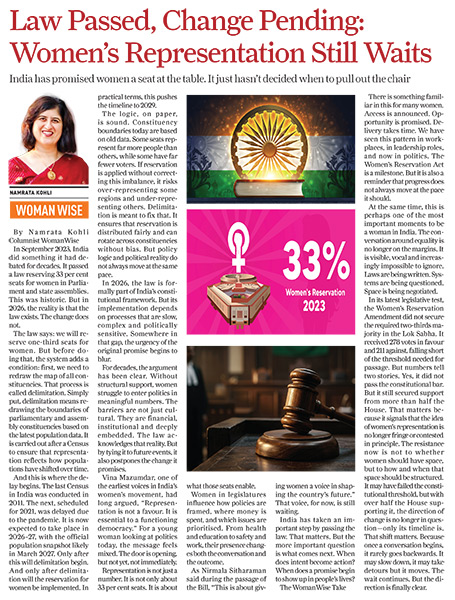
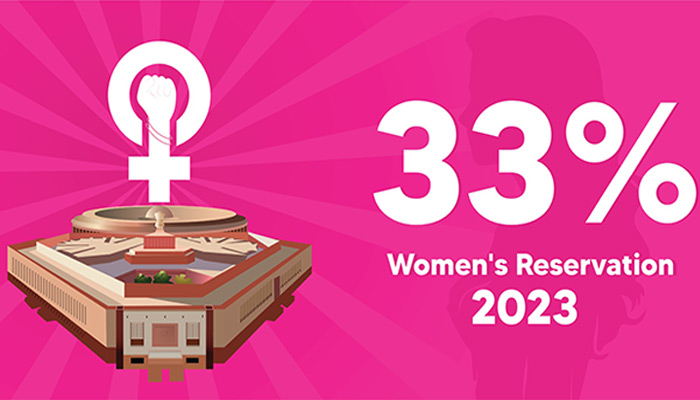
In September 2023, India did something it had debated for decades. It passed a law reserving 33 per cent seats for women in Parliament and state assemblies. This was historic. But in 2026, the reality is that the law exists. The change does not.
The law says: we will reserve one-third seats for women. But before doing that, the system adds a condition: first, we need to redraw the map of all constituencies. That process is called delimitation. Simply put, delimitation means re-drawing the boundaries of parliamentary and assembly constituencies based on the latest population data. It is carried out after a Census to ensure that representation reflects how populations have shifted over time.
And this is where the delay begins. The last Census in India was conducted in 2011. The next, scheduled for 2021, was delayed due to the pandemic. It is now expected to take place in 2026–27, with the official population snapshot likely in March 2027. Only after this will delimitation begin. And only after delimitation will the reservation for women be implemented. In practical terms, this pushes the timeline to 2029.
The logic, on paper, is sound. Constituency boundaries today are based on old data. Some seats rep- resent far more people than others, while some have far fewer voters. If reservation is applied without correcting this imbalance, it risks over-representing some regions and under-representing others. Delimitation is meant to fix that. It ensures that reservation is distributed fairly and can rotate across constituencies without bias. But policy logic and political reality do not always move at the same pace.
In 2026, the law is formally part of India’s constitutional framework. But its implementation depends on processes that are slow, complex and politically sensitive. Somewhere in that gap, the urgency of the original promise begins to blur.
For decades, the argument has been clear. Without structural support, women struggle to enter politics in meaningful numbers. The barriers are not just cultural. They are financial, institutional and deeply embedded. The law acknowledges that reality. But by tying it to future events, it also postpones the change it promises.
Vina Mazumdar, one of the earliest voices in India’s women’s movement, had long argued, “Representation is not a favour. It is essential to a functioning democracy.” For a young woman looking at politics today, the message feels mixed. The door is opening, but not yet, not immediately.
Representation is not just a number. It is not only about 33 per cent seats. It is about what those seats enable. Women in legislatures influence how policies are framed, where money is spent, and which issues are prioritised. From health and education to safety and work, their presence changes both the conversation and the outcome.
As Nirmala Sitharaman said during the passage of the Bill, “This is about giving women a voice in shaping the country’s future.” That voice, for now, is still waiting.
India has taken an important step by passing the law. That matters. But the more important question is what comes next. When does intent become action? When does a promise begin to show up in people’s lives? There is something familiar in this for many women. Access is announced. Opportunity is promised. Delivery takes time. We have seen this pattern in work- places, in leadership roles, and now in politics. The Women’s Reservation Act is a milestone. But it is also a reminder that progress does not always move at the pace it should.
At the same time, this is perhaps one of the most important moments to be a woman in India. The conversation around equality is no longer on the margins. It is visible, vocal and increasingly impossible to ignore. Laws are being written. Systems are being questioned. Space is being negotiated.

In its latest legislative test, the Women’s Reservation Amendment did not secure the required two-thirds majority in the Lok Sabha. It received 278 votes in favour and 211 against, falling short of the threshold needed for passage. But numbers tell two stories. Yes, it did not pass the constitutional bar. But it still secured support from more than half the House. That matters because it signals that the idea of women’s representation is no longer fringe or contested in principle. The resistance now is not to whether women should have space, but to how and when that space should be structured. It may have failed the constitutional threshold, but with over half the House supporting it, the direction of change is no longer in question—only its timeline is. That shift matters. Because once a conversation begins, it rarely goes backwards. It may slow down, it may take detours but it moves. The wait continues. But the direction is finally clear.