What we wear is a personal choice. But choice does not exist in a vacuum. Clothes have always spoken to context, climate and culture—and understanding the difference between freedom and appropriateness need not diminish either
There is an old Hindi saying: jaisa des, waisa bhes. The English have their own version: When in Rome, do as the Romans do. Both express an idea that seems almost unfashionable today: context matters.
I found myself thinking about this after the controversy surrounding Kriti Sanon’s recent Raksha Bandhan jewellery advertisement. The ad attracted criticism over the outfit she wore—a bralette-style blouse with a cape and draped skirt—and eventually the brand withdrew it. Kriti, meanwhile, defended herself against what she saw as policing of women’s clothes, arguing that culture and tradition reside in the heart, not in a woman’s neckline.
On one level, she is absolutely right. A woman’s morality cannot be measured by the length of her skirt or the depth of her neckline. We have spent far too many generations telling women what they can and cannot wear, and far too often clothing has been used to judge character.
But is that really the only question here? Surely there is a difference between policing a woman’s body and asking whether what we wear is appropriate to an occasion. If the same outfit had appeared on a red carpet, at a fashion event or in a glamorous evening campaign, would it have generated anything like the same conversation? Probably not. And therein lies the point.
Context Is Not Conservatism
I can wear a beautiful silk sari to a wedding. Wear the same sari into a swimming pool and people will stare—not because they oppose saris, but because the clothes and the context don’t belong together.

Equally, beachwear belongs perfectly naturally on a beach. It would be decidedly unusual at a board meeting. We instinctively understand these distinctions in almost every part of life. We dress differently for work, weddings, funerals, nightclubs, temples, gyms and holidays.
Why, then, has acknowledging appropriateness become synonymous with restricting women’s freedom? To my mind, dressing well has always involved three Cs: Context. Climate. Culture. What is the occasion? Where are you? Who will be there? These aren’t necessarily restrictions. They are forms of social intelligence.
Choice Comes With Context
The argument of individual choice also deserves greater nuance. Of course, women should choose what they wear. But practically every choice we make is shaped by context. We lower our voices in hospitals. We switch our phones off in theatres. We dress formally for certain professional situations. We remove our shoes before entering many places of worship. We don’t experience every act of adaptation as an assault on our freedom.
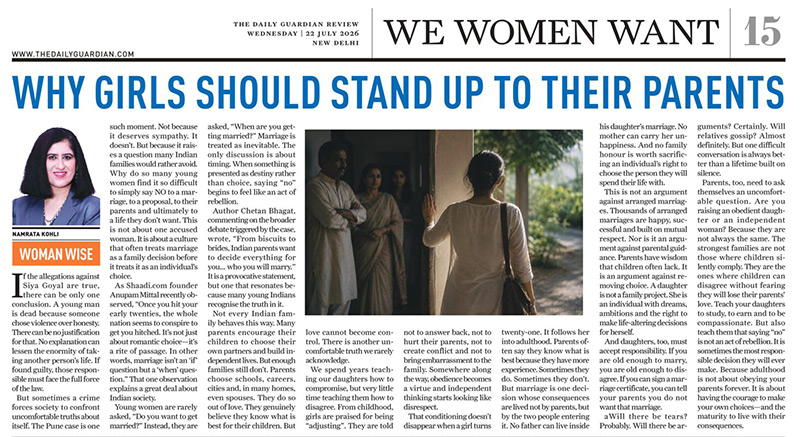
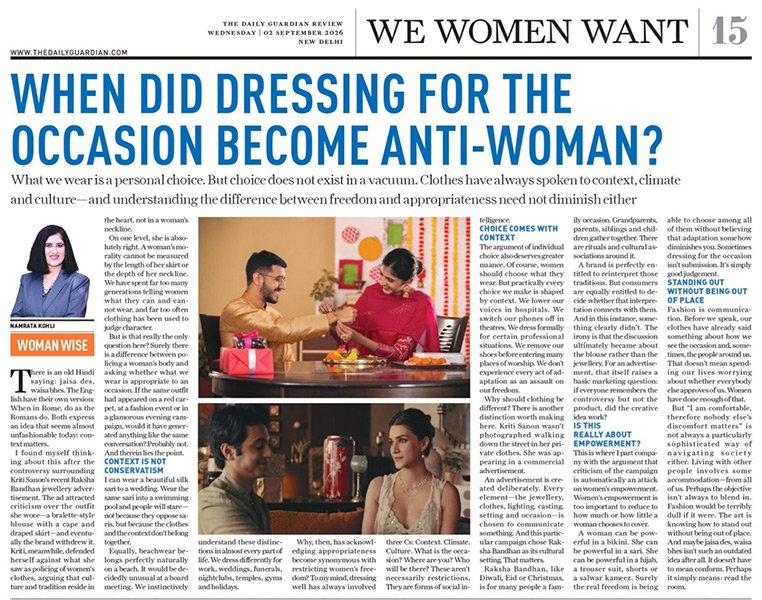
Why should clothing be different? There is another distinction worth making here. Kriti Sanon wasn’t photographed walking down the street in her private clothes. She was appearing in a commercial advertisement. An advertisement is created deliberately. Every element—the jewellery, clothes, lighting, casting, setting and occasion—is chosen to communicate something. And this particular campaign chose Raksha Bandhan as its cultural setting. That matters.

Raksha Bandhan, like Diwali, Eid or Christmas, is for many people a family occasion. Grandparents, parents, siblings and children gather together. There are rituals and cultural associations around it.
A brand is perfectly entitled to reinterpret those traditions. But consumers are equally entitled to decide whether that interpretation connects with them. And in this instance, something clearly didn’t. The irony is that the discussion ultimately became about the blouse rather than the jewellery. For an advertisement, that itself raises a basic marketing question: if everyone remembers the controversy but not the product, did the creative idea work?
Is This Really About Empowerment?
This is where I part company with the argument that criticism of the campaign is automatically an attack on women’s empowerment. Women’s empowerment is too important to reduce to how much or how little a woman chooses to cover.
A woman can be powerful in a bikini. She can be powerful in a sari. She can be powerful in a hijab, a trouser suit, shorts or a salwar kameez. Surely the real freedom is being able to choose among all of them without believing that adaptation somehow diminishes you. Sometimes dressing for the occasion isn’t submission. It’s simply good judgement.
Standing Out Without Being Out of Place
Fashion is communication. Before we speak, our clothes have already said something about how we see the occasion and, sometimes, the people around us. That doesn’t mean spending our lives worrying about whether everybody else approves of us. Women have done enough of that.
But “I am comfortable, therefore nobody else’s discomfort matters” is not always a particularly sophisticated way of navigating society either. Living with other people involves some accommodation—from all of us. Perhaps the objective isn’t always to blend in. Fashion would be terribly dull if it were. The art is knowing how to stand out without being out of place. And maybe jaisa des, waisa bhes isn’t such an outdated idea after all. It doesn’t have to mean conform. Perhaps it simply means: read the room.