Artificial intelligence could do more for women’s economic independence than many traditional interventions. But only if women move from being consumers of technology to creators of opportunity.
What if the biggest breakthrough for women’s empowerment doesn’t come from another policy, quota or corporate diversity programme, but from artificial intelligence?
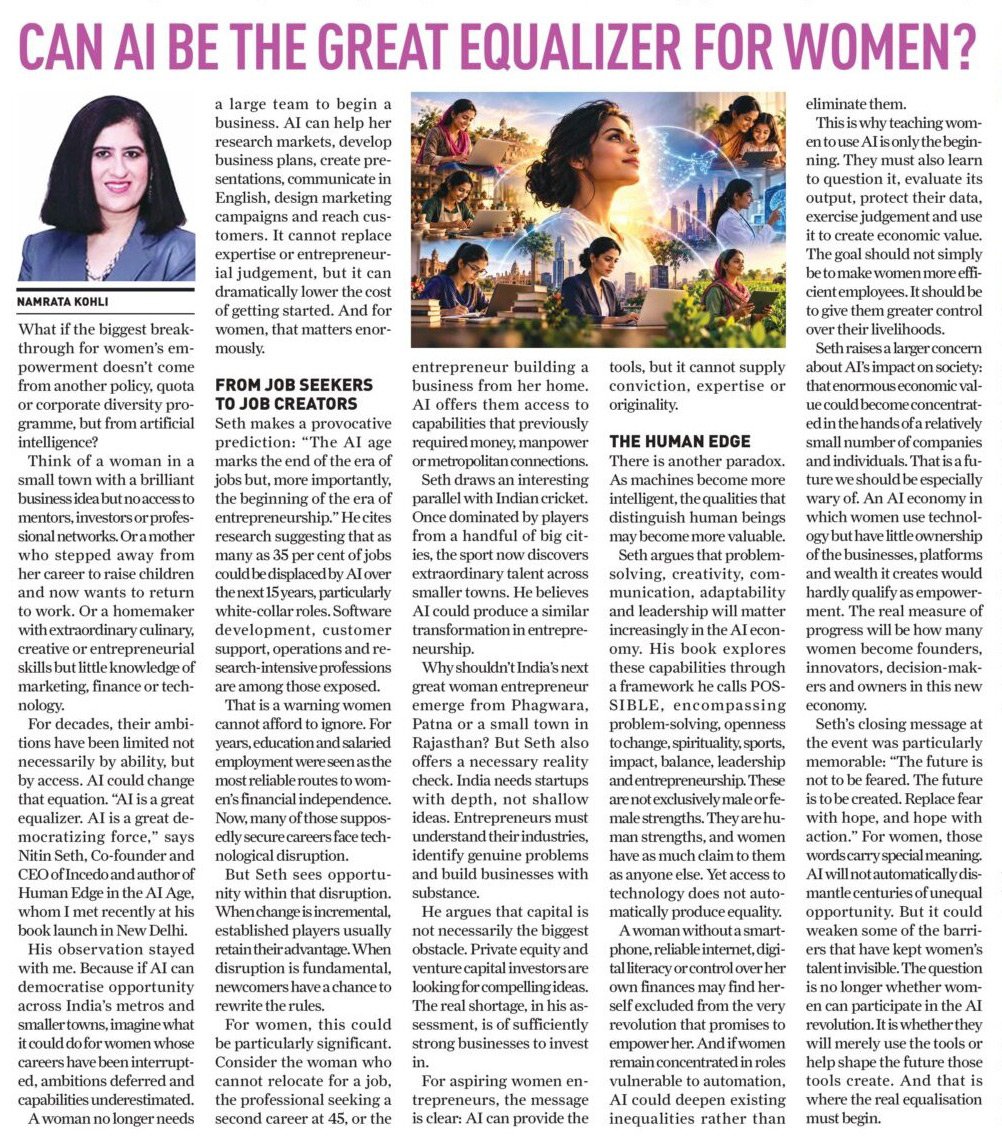
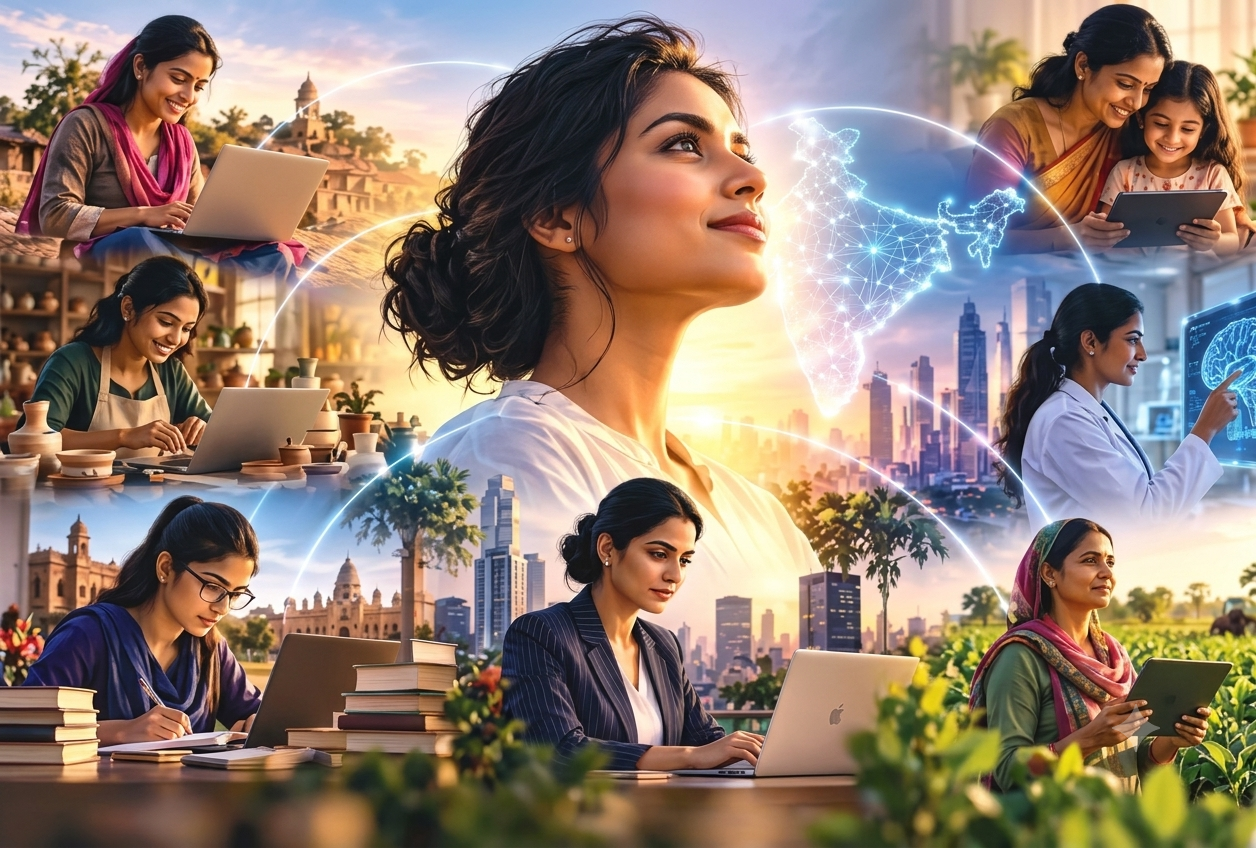
Think of a woman in a small town with a brilliant business idea but no access to mentors, investors or professional networks. Or a mother who stepped away from her career to raise children and now wants to return to work. Or a homemaker with extraordinary culinary, creative or entrepreneurial skills but little knowledge of marketing, finance or technology.
For decades, their ambitions have been limited not necessarily by ability, but by access. AI could change that equation. “AI is a great equalizer. AI is a great democratizing force,” says Nitin Seth, Co-founder and CEO of Incedo and author of Human Edge in the AI Age, whom I met recently at his book launch in New Delhi.
His observation stayed with me. Because if AI can democratise opportunity across India’s metros and smaller towns, imagine what it could do for women whose careers have been interrupted, ambitions deferred and capabilities underestimated. A woman no longer needs a large team to begin a business. AI can help her research markets, develop business plans, create presentations, communicate in English, design marketing campaigns and reach customers. It cannot replace expertise or entrepreneurial judgement, but it can dramatically lower the cost of getting started. And for women, that matters enormously.
From Job Seekers to Job Creators
Seth makes a provocative prediction: “The AI age marks the end of the era of jobs but, more importantly, the beginning of the era of entrepreneurship.” He cites research suggesting that as many as 35 per cent of jobs could be displaced by AI over the next 15 years, particularly white-collar roles. Software development, customer support, operations and research-intensive professions are among those exposed.
That is a warning women cannot afford to ignore. For years, education and salaried employment were seen as the most reliable routes to women’s financial independence. Now, many of those supposedly secure careers face technological disruption. But Seth sees opportunity within that disruption. When change is incremental, established players usually retain their advantage. When disruption is fundamental, newcomers have a chance to rewrite the rules.
For women, this could be particularly significant. Consider the woman who cannot relocate for a job, the professional seeking a second career at 45, or the entrepreneur building a business from her home. AI offers them access to capabilities that previously required money, manpower or metropolitan connections.
Seth draws an interesting parallel with Indian cricket. Once dominated by players from a handful of big cities, the sport now discovers extraordinary talent across smaller towns. He believes AI could produce a similar transformation in entrepreneurship.
Why shouldn’t India’s next great woman entrepreneur emerge from Phagwara, Patna or a small town in Rajasthan? But Seth also offers a necessary reality check. India needs startups with depth, not shallow ideas. Entrepreneurs must understand their industries, identify genuine problems and build businesses with substance.
He argues that capital is not necessarily the biggest obstacle. Private equity and venture capital investors are looking for compelling ideas. The real shortage, in his assessment, is of sufficiently strong businesses to invest in. For aspiring women entrepreneurs, the message is clear: AI can provide the tools, but it cannot supply conviction, expertise or originality.
The Human Edge
There is another paradox. As machines become more intelligent, the qualities that distinguish human beings may become more valuable.
Seth argues that problem-solving, creativity, communication, adaptability and leadership will matter increasingly in the AI economy. His book explores these capabilities through a framework he calls POSSIBLE, encompassing problem-solving, openness to change, spirituality, sports, impact, balance, leadership and entrepreneurship.
These are not exclusively male or female strengths. They are human strengths, and women have as much claim to them as anyone else. Yet access to technology does not automatically produce equality.
A woman without a smartphone, reliable internet, digital literacy or control over her own finances may find herself excluded from the very revolution that promises to empower her. And if women remain concentrated in roles vulnerable to automation, AI could deepen existing inequalities rather than eliminate them.
This is why teaching women to use AI is only the beginning. They must also learn to question it, evaluate its output, protect their data, exercise judgement and use it to create economic value. The goal should not simply be to make women more efficient employees. It should be to give them greater control over their livelihoods.
Seth raises a larger concern about AI’s impact on society: that enormous economic value could become concentrated in the hands of a relatively small number of companies and individuals. That is a future we should be especially wary of. An AI economy in which women use technology but have little ownership of the businesses, platforms and wealth it creates would hardly qualify as empowerment.
The real measure of progress will be how many women become founders, innovators, decision-makers and owners in this new economy. Seth’s closing message at the event was particularly memorable: “The future is not to be feared. The future is to be created. Replace fear with hope, and hope with action.” For women, those words carry special meaning. AI will not automatically dismantle centuries of unequal opportunity. But it could weaken some of the barriers that have kept women’s talent invisible.
The question is no longer whether women can participate in the AI revolution. It is whether they will merely use the tools or help shape the future those tools create. And that is where the real equalisation must begin.