There was a time when selling a luxury home was relatively straightforward. Give the buyer a large apartment in a good location, use expensive finishes, build an impressive clubhouse, and throw in a swimming pool or a tennis court.
Then came the amenity wars. Spas, private cinemas, golf simulators, business lounges, concierge desks, temperature-controlled pools — the lists became longer as developers tried to outdo one another. Today, when many premium projects offer broadly similar trappings, buyers are beginning to look beyond the brochure.
A rather basic question is gaining importance: How many people am I going to share all this with? Privacy, tower spacing, open areas, apartments per floor and even the number of families sharing a lift are entering the luxury-home conversation. In some projects, developers are deliberately building fewer homes than they could have.
Less, it appears, is acquiring a premium. “Post-Covid, buyers have consistently prioritised projects with fewer families sharing lifts, lobbies, and common amenities,” says Gaurav Mavi, co-founder of BOP.in, a Delhi-NCR-based real-estate advisory platform. He sees such preferences particularly among business owners, senior corporate professionals, and non-resident Indians (NRIs).
The trend is no longer confined to the rarefied ₹10-crore-plus end of the market. According to Mavi, buyers in the ₹2 crore–₹5 crore bracket are also beginning to consider density while comparing homes. There is a price attached to that preference. If two projects are broadly comparable in location, construction quality, specifications, developer credibility and amenities, Mavi estimates that the lower-density development could command a 5–15 per cent premium. At the very top end of the market, it can be higher.
“The market has shifted from amenity-led luxury to experience-led luxury,” he says.
The space between matters
However, a project with fewer apartments per acre is not necessarily a better place to live. “The new measure of luxury is not how much we build, but how much we consciously choose not to build,” says Sonali Rastogi, founder and vice chairperson, Morphogenesis, a leading architecture and urban design firm. “In increasingly dense cities, the real premium is the space preserved for light, air, landscape, privacy and people.”
Rastogi cautions buyers against judging a development by a single number. Homes per acre matter, but so do FAR or FSI, ground coverage, tower spacing, population density and the number of residents sharing common facilities.
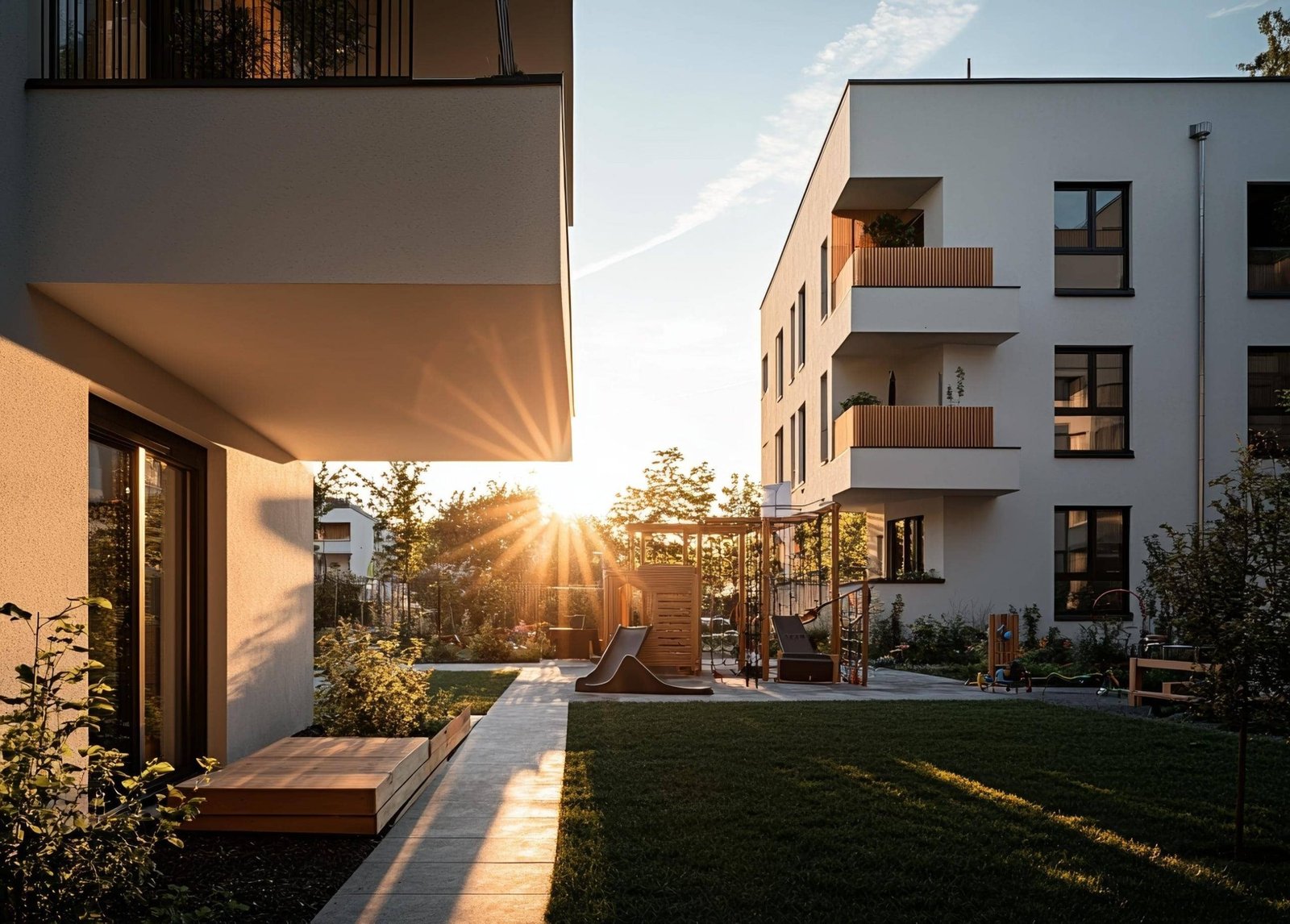
And then there is that favourite phrase in property advertising: “open space”. Seventy per cent open sounds impressive. But what exactly is open? A landscaped lawn where children can play is very different from a driveway, ramp or leftover strip around a tower. Buyers should find out how much of the promised open area is genuinely usable, landscaped and free from vehicles.
Tower placement matters too. A development can have relatively few apartments and still feel cramped if buildings are too close, balconies look directly into neighbouring homes or common facilities have to serve a large population.
“In luxury housing, the spaces between buildings can matter more than a few hundred additional square feet within the apartment,” says Rastogi. It is an interesting way of looking at the value of a home. We tend to obsess over the area we are buying. Increasingly, the area we are not buying but which surrounds us may matter just as much. “Luxury begins long before one enters the home,” she says.
The economics of building less
“Low-density living, simply put, means fewer homes on more land,” says Moheet Kalia, senior vice president, (sales and marketing) at HCBS, a realty firm. “It translates into more open space, better ventilation, greater privacy, and a quieter community.”
At HCBS Twin Horizon in Sector 102, Dwarka Expressway, 268 residences are spread across 5.3 acres in two standalone towers — approximately 51 homes per acre. HCBS says this compares with around 70–80 units per acre in many premium and luxury developments along the Dwarka expressway corridor. For a buyer, the difference between 50 and 70 homes per acre may not mean much on paper. Kalia says it becomes more apparent in everyday life: fewer people sharing lifts, lobbies and common amenities, better natural light and ventilation, and more breathing room around the towers.
But why would a developer give up saleable density? Kalia says it is less a sacrifice than a different commercial model. “When you build at higher density, you are optimising for volume. When you build at lower density, you are optimising for price per unit and buyer quality,” he notes.
The equation works only if the market will support it. Can the cost of expensive land be recovered from fewer homes? Is the difference substantial enough to justify a higher price? And will buyers continue to buy at that price? That is the gamble behind low-density luxury. The developer builds less, but each home and the space around it has to become more valuable.
The thinking is not restricted to NCR. Take the case of Tribhuja, a ₹3,000-crore residential project being developed by Zuari Infraworld and Gangothri Infraedge at Kollur in Hyderabad, the interesting number is not simply how many homes are being built. It is how many were dropped from the plan. Spread across 9.16 acres, Tribhuja will have nine towers and 1,730 three- and four-bedroom residences. Saroj Kumar Poddar, Chairman, Zuari Industries Limited, says the developers consciously gave up the opportunity to build nearly 94 additional homes in favour of a better living environment.
K. Madhuram Reddy, Managing Director, Gangothri Infraedge Private Limited, is candid about the commercial tension. “The reality of real estate is everybody wants to maximise the return per square foot,” he says. His argument is that buyers often experience luxury through surprisingly ordinary things. Take elevators. Tribhuja has four elevators serving four apartments per floor. Or ceiling height: the residences have a floor-to-ceiling height of around 10.5 feet, which Reddy says creates the volume and sense of openness more often associated with a villa. The project was launched at around ₹7,000 per sq ft, and Reddy says the intention was to provide such features at ticket sizes below ₹2 crore.
That matters because the desire for space is often treated as an ultra-luxury phenomenon. It need not be. A ₹2-crore buyer may value sunlight, privacy and a quick elevator just as much as a ₹10-crore buyer does. The question is how much of it can be delivered at that price.
Do your own ‘Density Check’
This is where buyers need to be wary. Real estate has a habit of discovering attractive new adjectives. ‘Green’ became ubiquitous. So did ‘wellness’, ‘sustainable’ and ‘luxury’. Low density could easily be next.
Don’t buy the adjective. Check the project. Start with the obvious numbers: total land parcel, total residences and homes per acre. Compare them with similar developments in the same micro-market. Ask about FAR/FSI and ground coverage. Then look beyond the arithmetic. How far apart are the towers? How many apartments are there on each floor? How many lifts serve them? How many people will eventually live in the development? Is the open space genuinely green and usable, or does it include driveways and ramps? How many residents will share the clubhouse, swimming pool, gym and sports facilities?
And ask to see the approved masterplan. A project can look wonderfully spacious when its first towers are being marketed and considerably less so once subsequent phases are built. Most importantly, don’t assume lower density deserves whatever premium a developer chooses to attach to it. If a comparable home nearby costs 10 per cent less, there should be something tangible in return for that extra money.
For Ayushman Mehta, a 45-year-old Gurugram-based investor, the things that matter are surprisingly different from what a builder sells: “Sunlight coming through the window, air moving through the apartment, trees outside the balcony, a lift that arrives quickly, a pool that isn’t packed and a decent distance from the next tower and my room cannot overlook another’s balcony.”
Perhaps that is where the definition of luxury is changing. For years, luxury real estate sold the visible: marble, chandeliers, clubhouses and ever-longer amenity lists. Lower-density living sells something harder to photograph in a brochure — absence.
You may never own those spaces. But you live with them every day. And in increasingly crowded Indian cities, the most expensive thing a developer may be able to sell you is simply room to breathe.