A new report points to a structural shift in India’s music market as independent artists, regional languages and global listeners challenge the traditional dominance of film music
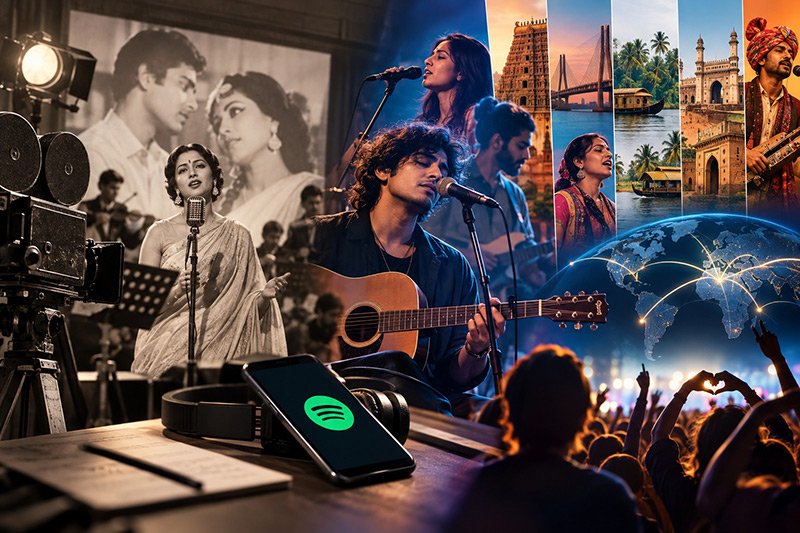
For decades, the route to becoming a music star in India usually ran through cinema. Singers became famous through playback, songs travelled on the back of films, and soundtracks dominated popular listening. That model is now being disrupted.
A new report on India’s streaming economy suggests that artist-first music — tracks created and released outside film soundtracks — is rapidly moving into the mainstream. According to Spotify’s Loud & Clear India report, half of its year-end top 10 in India in 2025 came from outside film soundtracks, while 90 per cent of tracks on its Daily Top 50 were by Indian artists.
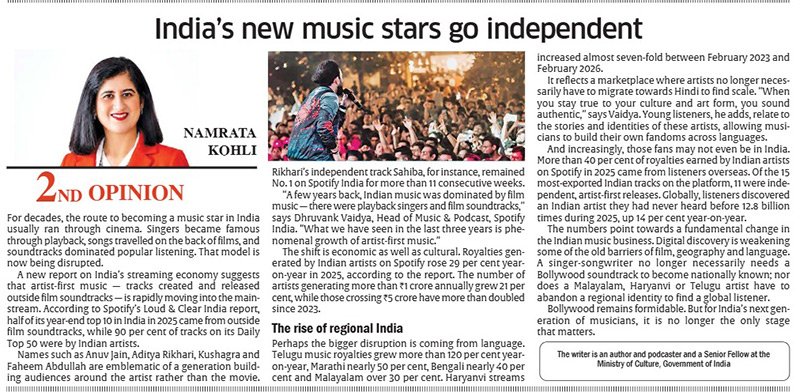
Names such as Anuv Jain, Aditya Rikhari, Kushagra and Faheem Abdullah are emblematic of a generation building audiences around the artist rather than the movie. Rikhari’s independent track Sahiba, for instance, remained No. 1 on Spotify India for more than 11 consecutive weeks.
“A few years back, Indian music was dominated by film music — there were playback singers and film soundtracks,” says Dhruvank Vaidya, Head of Music & Podcast, Spotify India. “What we have seen in the last three years is phenomenal growth of artist-first music.”
The shift is economic as well as cultural. Royalties generated by Indian artists on Spotify rose 29 per cent year-on-year in 2025, according to the report. The number of artists generating more than ₹1 crore annually grew 21 per cent, while those crossing ₹5 crore have more than doubled since 2023.
The rise of regional India
Perhaps the bigger disruption is coming from language. Telugu music royalties grew more than 120 per cent year-on-year, Marathi nearly 50 per cent, Bengali nearly 40 per cent and Malayalam over 30 per cent. Haryanvi streams increased almost seven-fold between February 2023 and February 2026.
It reflects a marketplace where artists no longer necessarily have to migrate towards Hindi to find scale. “When you stay true to your culture and art form, you sound authentic,” says Vaidya. Young listeners, he adds, relate to the stories and identities of these artists, allowing musicians to build their own fandoms across languages.
And increasingly, those fans may not even be in India. More than 40 per cent of royalties earned by Indian artists on Spotify in 2025 came from listeners overseas. Of the 15 most-exported Indian tracks on the platform, 11 were independent, artist-first releases. Globally, listeners discovered an Indian artist they had never heard before 12.8 billion times during 2025, up 14 per cent year-on-year.
The numbers point towards a fundamental change in the Indian music business. Digital discovery is weakening some of the old barriers of film, geography and language. A singer-songwriter no longer necessarily needs a Bollywood soundtrack to become nationally known; nor does a Malayalam, Haryanvi or Telugu artist have to abandon a regional identity to find a global listener.
Bollywood remains formidable. But for India’s next generation of musicians, it is no longer the only stage that matters.