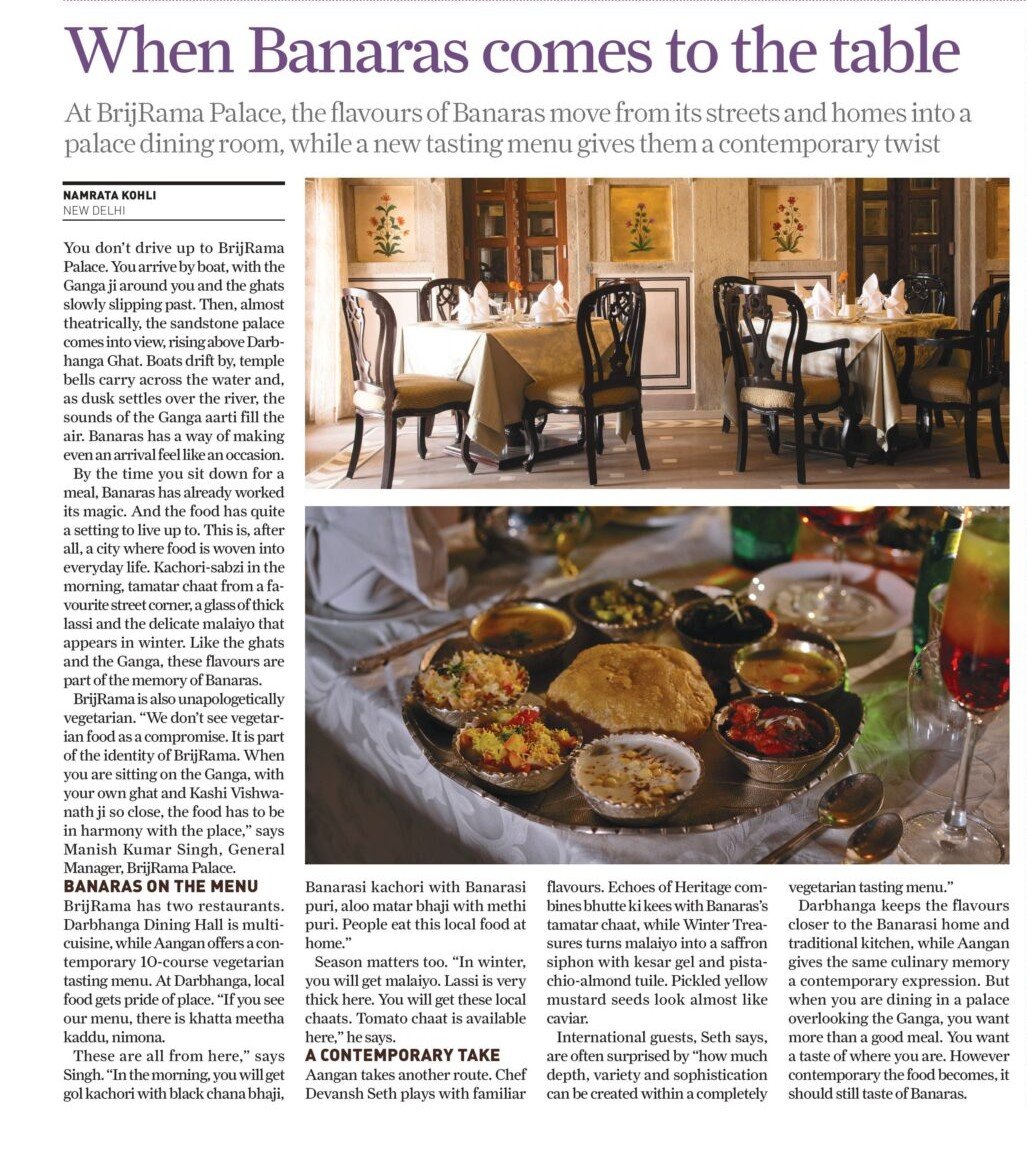
At BrijRama Palace, the flavours of Banaras move from its streets and homes into a palace dining room, while a new tasting menu gives them a contemporary twist
You don’t drive up to BrijRama Palace. You arrive by boat. The Ganga is around you, the ghats pass by one after another and then the sandstone palace appears, rising dramatically above Darbhanga Ghat. You step off the boat and climb towards a building that seems almost suspended between the river and the old city. Temple bells ring somewhere in the distance. Boats continue to drift past. As evening falls, the sounds of the Ganga aarti take over.
By the time you sit down for dinner, Banaras has already made quite an entrance.Now the food has to live up to it. That is especially interesting in a city where some of the greatest food was never meant for fine china. Kachori-sabzi for breakfast, tamatar chaat that is sweet, sour, spicy and messy, thick lassi, and malaiyo on a winter morning. This is food eaten on the street and in homes. It belongs as much to Banaras as its ghats and temples.
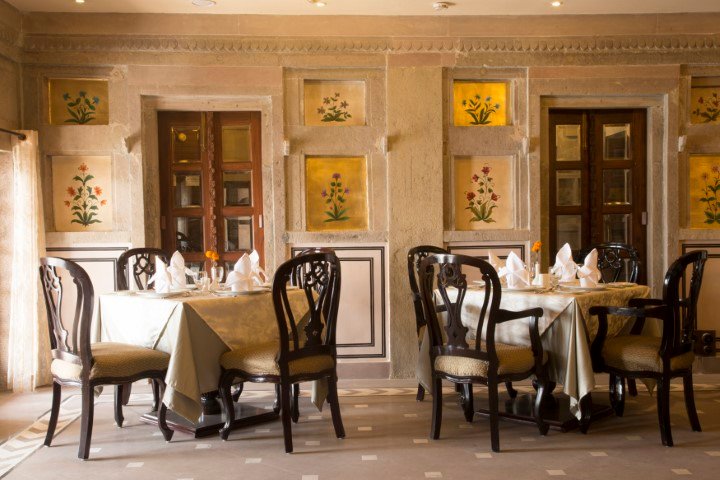
So what happens when it enters a palace dining room? BrijRama is also completely and unapologetically vegetarian. “We don’t see vegetarian food as a compromise. It is part of the identity of BrijRama. When you are sitting on the Ganga, with your own ghat and Kashi Vishwanath ji so close, the food has to be in harmony with the place,” says Manish Kumar Singh, General Manager, BrijRama Palace.
Could a luxury hotel catering to guests from across the world not make an exception? Singh doesn’t see the need. “Some people do it, but when we say we are a traditional hotel, we don’t need to.”
Banaras on the Menu
There are two restaurants at BrijRama. Darbhanga Dining Hall is multi-cuisine, while the recently launched Aangan serves a contemporary 10-course vegetarian tasting menu.
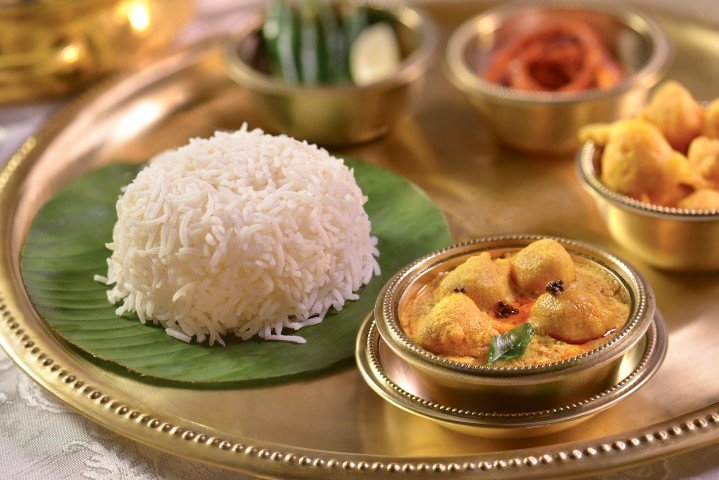
Darbhanga offers Italian and Oriental food, but local food gets pride of place. “We have NRI guests and foreigners and they want to explore Indian food,” says Gulbansh Singh Yadav, Restaurant Manager, Darbhanga Dining Hall. Its bestseller is the four-course Darbhanga Thali, priced at Rs 3,500 plus taxes. There is potli ki sabzi with dal ki wadi, dal panchmel made with five pulses and nimona rice.
“Local food is what we push,” shares Manish Kumar Singh who reels off the local favourites with ease. “If you see our menu, there is khatta meetha kaddu, nimona. These are all from here. In the morning, you will get gol kachori with black chana bhaji, Banarasi kachori with Banarasi puri, aloo matar bhaji with methi puri. People eat this local food at home.”
Then there is the food Banaras is famous for. “In winter, you will get malaiyo. Lassi is very thick here. You will get these local chaats. Tomato chaat is available here,” says Singh. There is also aloo tikki, laung lata and lal peda. “These are local to this region. You will get all these. This is the food.”
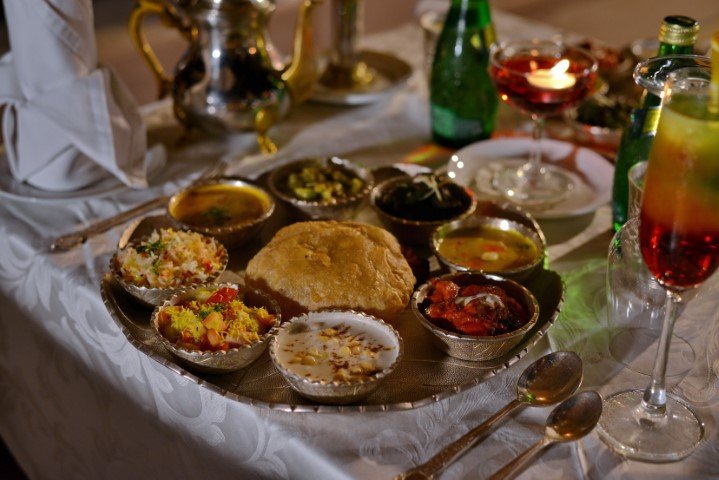
Much of it is simple food associated with homes, streets and halwai shops. Bringing it into a luxury hotel does not mean dressing it up. A kachori still has to be crisp. The sabzi still needs punch. Tamatar chaat cannot lose its sweet, sour and spicy character just because it is being served in a palace.
A Contemporary Take
Aangan takes a different route. Chef Devansh Seth uses familiar flavours and ingredients and plays with them. Echoes of Heritage combines bhutte ki kees with the flavours of Banaras’s tamatar chaat. Winter Treasures turns malaiyo into a light saffron siphon with kesar gel and pistachio-almond tuile. Yellow mustard seeds are lightly pickled until they look almost like caviar.
What surprises many international guests, says Seth, is what can be done with an entirely vegetarian menu. “One of the most common reactions we receive from international guests is their surprise at how much depth, variety and sophistication can be created within a completely vegetarian tasting menu,” he says. “Many guests arrive with the perception that Indian vegetarian food is centred around a few familiar curries, breads, lentils or vegetable preparations.”
Aangan, he says, challenges that perception through ten courses with different “textures, temperatures, techniques, flavours and presentations.” Luxury does not have to mean piling expensive ingredients onto the plate. “For us, luxury is not defined simply by the cost of an ingredient. It is defined by thought, precision, time and the depth of the experience we create around it,” says Seth.
Singh is equally clear that serving an international clientele does not mean abandoning local food. “If I am catering to a diverse clientele, we have to keep a diverse offering. We have Indian, Oriental and Continental food.”
Finally, Darbhanga keeps the flavours closer to the Banarasi home and traditional kitchen. Aangan takes the same culinary memory and gives it a contemporary expression. Both have their place.
But when you are dining in a palace overlooking the Ganga, you want more than a good meal. You want a taste of where you are. However contemporary the food becomes, it should still taste of Banaras.