Jazz is having a moment. Once associated with smoky clubs, serious aficionados and a relatively niche audience in India, it is finding a new generation of listeners and learners.
Part of the attraction lies in the music itself. Jazz has rules, but it also gives you permission to break away from them. Musicians can take a familiar melody and make it their own, improvising, responding to one another and creating something different each time they play. That spontaneity is drawing people not just to jazz clubs and live gigs, but also to piano, saxophone and vocal lessons, workshops and jam sessions.
Take entrepreneur Ajay Bijli, founder of PVR and Managing Director of PVR INOX, for whom music has long been more than a passing interest. Jazz, he says, has influenced not only what he listens to, but how he learns. “What I find beautiful about it is the balance between structure and freedom. There is a strong foundation, but within it, musicians have the freedom to listen, respond and express themselves in the moment.”
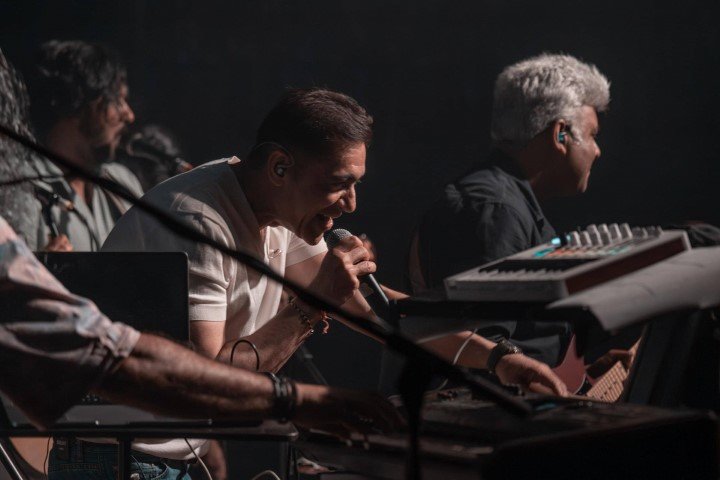
Bijli, who calls himself a lifelong student of music, recently took that relationship further with On Another Note…, marking his emergence as an independent music artist. Improvisation is something he is consciously exploring. “You cannot simply fall back on what you have rehearsed; you have to listen and respond.”
That combination of discipline and freedom is at the heart of learning jazz. “Structure gives us confidence,” he says, “but it is the freedom within that structure that allows us to truly express ourselves.”
Learning jazz
Formal jazz education remains relatively limited in India. Global Music Institute in Greater Noida and Swarnabhoomi Academy of Music near Chennai are among institutions offering structured contemporary music training, while KM Music Conservatory in Chennai and NMIMS School of Performing Arts in Mumbai offer broader Western and contemporary music programmes. Much of the learning, however, still happens through independent teachers, private lessons, listening, practice and, crucially, playing with other musicians.
Some of India’s leading jazz instrumentalists include Louiz Banks, Braz Gonsalves, Trilok Gurtu, Gino Banks, Ranjit Barot and Rhythm Bansal. Among vocalists, prominent names include Asha Puthli, Usha Uthup, Radha Thomas, Vasundhara Vee, Sonia Saigal and Sanjeeta Bhattacharya.
Arjun Sagar Gupta, founder of The Piano Man and himself a jazz pianist, came to jazz first as a listener. Growing up in the 1990s, he remembers his father bringing home music from around the world. Then his brother gave him a CD of Louis Armstrong playing W.C. Handy’s blues. “I can sing every solo on that CD till date,” he says. “It was such an impressionable age.”
Later, at the Delhi School of Music, his teacher John Raphael started him on Western classical music. He would spend a few months studying classical repertoire before moving into jazz standards, improvisation and harmonic extensions, and then move back again. Gupta describes classical grounding as a “toolkit”.
His journey says something important about learning jazz. Formal lessons matter, but so does what happens before the first lesson: what music enters a home, what a child hears, which record somebody happens to hand you and whether curiosity is allowed to take over.
When listening becomes learning
Jazz vocalist Parvati Mohan Krishnan grew up surrounded by music. She trained in Hindustani classical, while her Carnatic-trained mother introduced her to rock and roll, blues, pop and jazz. Records and cassettes arrived from uncles abroad, and by college she was performing with both the Western and Indian music societies at Lady Shri Ram College.
Her deeper immersion in jazz came through an uncle associated with Jazz Utsav, who took her to performances at Haze, the blues club in Vasant Vihar, and introduced her to musicians. “That’s where the foundation was laid. My voice simply flowed into jazz,” she says, crediting Nikhil Mawkin of BollyJazz and Arjun Sagar Gupta for later pushing her further.
Her journey underlines something central to learning jazz: lessons are only part of the education. Listening matters just as much. “Listening is what opens the genre up to you,” says Krishnan. “It tells you that you’re not the first to do what you did, and that you’re one tiny figure in an ocean of jazz musicians.” The goal, however, is not imitation but finding your own voice through interpretation, emotion and performance. Her classical training provided the foundation, but jazz became her preferred language of expression.
“I found that jazz was the smoothest way for me to express myself,” she says. Today, that instinct crosses genres. “Whether I’m singing Cher’s ‘Believe’, a Beatles number or an ABBA song, my approach to it is jazz.”
The business of jazz
Can jazz pay the bills? For many musicians in India, the answer lies in not depending on jazz alone. Teaching, studio and commercial projects, corporate performances and India’s enormous wedding market can all form part of the income mix.
Take the case of Copycats, a popular band that performs at weddings and corporate events around the world. Bands on the wedding circuit can command fees running into double-digit lakhs, Gupta says, as demand for live acts grows. “The ecosystem around weddings is very mature and developed in India. It is a very large market and there is a lot of money there.” More importantly, he adds, “that is what is actually giving sustainability to a lot of the music scene.”
But a thriving jazz economy cannot depend on weddings and corporate gigs alone. Audiences also have to be willing to pay to hear musicians they may not already know. “The ecosystem has to be viable independent of who’s playing,” says Gupta. What the market needs, he argues, is a greater “hunger for discovery”.
At The Piano Man, the philosophy is quite literally “Artist First”. “We train our team that your first guest is the artist and your second guest is the customer,” he says. That philosophy also has to work commercially. Ticketing now accounts for around 17-18 percent of the group’s revenue, Gupta says. His approach to pricing is straightforward: ticket revenue should cover what the artist needs to be paid as well as the cost of producing the show.
Krishnan is equally candid about the musician’s side of the equation. “Yes, you can make a living from it, but it is unpredictable, and to really earn from it you have to be good and put in the hard work.” She chose not to depend on music for her livelihood. “It takes guts to be in a space that is so crowded and so unpredictable. I wasn’t able to do that. I’ve always kept my music second to my job.” Yet she has watched younger musicians build careers through persistence. “Hard work pays off. It takes time and some struggle,” she says.
That, perhaps, is the circle of India’s emerging jazz economy. Listening creates curiosity, curiosity leads to learning, learning leads to performing and performing, if the ecosystem works, leads to earning.
But jazz also offers an interesting lesson for a world in which almost everything can be bought instantly. You can pay for the piano, the saxophone, the lessons and the concert ticket. You cannot buy the hours of listening, practice and experimentation that turn technique into music.
And perhaps that is ultimately what separates playing the notes from making music. As Gupta says of pianist Rhythm Bansal: “When he plays jazz, the piano sings.”