If the allegations against Siya Goyal are true, there can be only one conclusion. A young man is dead because someone chose violence over honesty. There can be no justification for that. No explanation can lessen the enormity of taking another person’s life. If found guilty, those responsible must face the full force of the law.
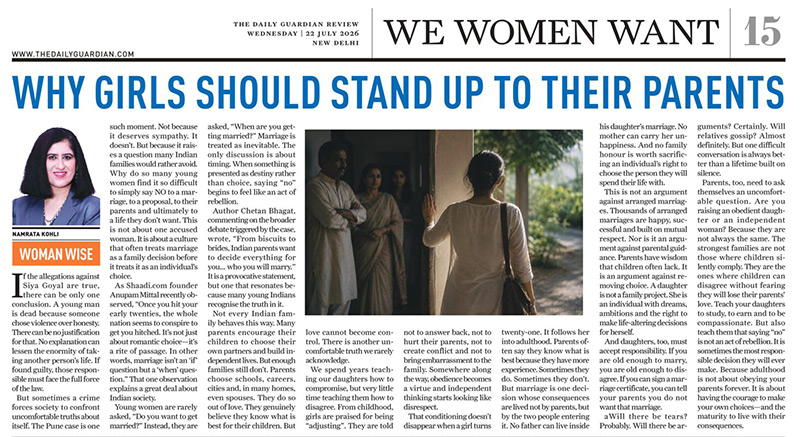
But sometimes a crime forces society to confront uncomfortable truths about itself. The Pune case is one such moment. Not because it deserves sympathy. It doesn’t. But because it raises a question many Indian families would rather avoid. Why do so many young women find it so difficult to simply say NO to a marriage, to a proposal, to their parents and ultimately to a life they don’t want? This is not about one accused woman. It is about a culture that often treats marriage as a family decision before it treats it as an individual’s choice.
As Shaadi.com founder Anupam Mittal recently observed, “Once you hit your early twenties, the whole nation seems to conspire to get you hitched. It’s not just about romantic choice—it’s a rite of passage. In other words, marriage isn’t an ‘if’ question but a ‘when’ question.” That one observation explains a great deal about Indian society.
Young women are rarely asked, “Do you want to get married?” Instead, they are asked, “When are you getting married?” Marriage is treated as inevitable. The only discussion is about timing. When something is presented as destiny rather than choice, saying “no” begins to feel like an act of rebellion.
Author Chetan Bhagat, commenting on the broader debate triggered by the case, wrote, “From biscuits to brides, Indian parents want to decide everything for you… who you will marry.” It is a provocative statement, but one that resonates because many young Indians recognise the truth in it.

Not every Indian family behaves this way. Many parents encourage their children to choose their own partners and build independent lives. But enough families still don’t. Parents choose schools, careers, cities and, in many homes, even spouses. They do so out of love. They genuinely believe they know what is best for their children. But love cannot become control. There is another uncomfortable truth we rarely acknowledge.
We spend years teaching our daughters how to compromise, but very little time teaching them how to disagree. From childhood, girls are praised for being “adjusting”. They are told not to answer back, not to hurt their parents, not to create conflict and not to bring embarrassment to the family. Somewhere along the way, obedience becomes a virtue and independent thinking starts looking like disrespect.
That conditioning doesn’t disappear when a girl turns twenty-one. It follows her into adulthood. Parents often say they know what is best because they have more experience. Sometimes they do. Sometimes they don’t. But marriage is one decision whose consequences are lived not by parents, but by the two people entering it. No father can live inside his daughter’s marriage. No mother can carry her unhappiness. And no family honour is worth sacrificing an individual’s right to choose the person they will spend their life with.
This is not an argument against arranged marriages. Thousands of arranged marriages are happy, successful and built on mutual respect. Nor is it an argument against parental guidance. Parents have wisdom that children often lack. It is an argument against removing choice. A daughter is not a family project. She is an individual with dreams, ambitions and the right to make life-altering decisions for herself.
And daughters, too, must accept responsibility. If you are old enough to marry, you are old enough to disagree. If you can sign a marriage certificate, you can tell your parents you do not want that marriage.
Will there be tears? Probably. Will there be arguments? Certainly. Will relatives gossip? Almost definitely. But one difficult conversation is always better than a lifetime built on silence.
Parents, too, need to ask themselves an uncomfortable question. Are you raising an obedient daughter or an independent woman? Because they are not always the same. The strongest families are not those where children silently comply. They are the ones where children can disagree without fearing they will lose their parents’ love. Teach your daughters to study, to earn and to be compassionate. But also teach them that saying “no” is not an act of rebellion. It is sometimes the most responsible decision they will ever make. Because adulthood is not about obeying your parents forever. It is about having the courage to make your own choices—and the maturity to live with their consequences.