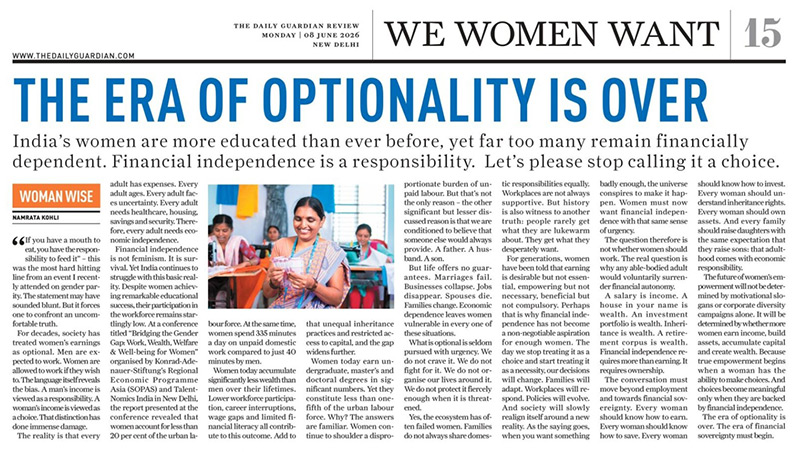
India’s women are more educated than ever before, yet far too many remain financially dependent. Financial independence is a responsibility. Let’s please stop calling it a choice.
“If you have a mouth to eat, you have the responsibility to feed it” – this was the most hard hitting line from an event I recently attended on gender parity. The statement may have sounded blunt. But it forces one to confront an uncomfortable truth.
For decades, society has treated women’s earnings as optional. Men are expected to work. Women are allowed to work if they wish to. The language itself reveals the bias. A man’s income is viewed as a responsibility. A woman’s income is viewed as a choice. That distinction has done immense damage.
The reality is that every badly enough, the universe conspires to make it happen. Women must now want financial independence with that same sense of urgency. tic responsibilities equally. Workplaces are not always supportive. But history is also witness to another truth: people rarely get what they are lukewarm about. They get what they desperately want. bour force. At the same time, women spend 335 minutes a day on unpaid domestic work compared to just 40 minutes by men. adult has expenses. Every adult ages. Every adult faces uncertainty. Every adult needs healthcare, housing, savings and security. Therefore, every adult needs economic independence.
Financial independence is not feminism. It is survival. Yet India continues to struggle with this basic reality. Despite women achieving remarkable educational success, their participation in the workforce remains startlingly low. At a conference titled “Bridging the Gender Gap: Work, Wealth, Welfare & Well-being for Women” organised by Konrad-Adenauer-Stiftung’s Regional Economic Programme Asia (SOPAS) and TalentNomics India in New Delhi, the report presented at the conference revealed that women account for less than 20 per cent of the urban labour force. At the same time, women spend 335 minutes a day on unpaid domestic work compared to just 40 minutes by men.
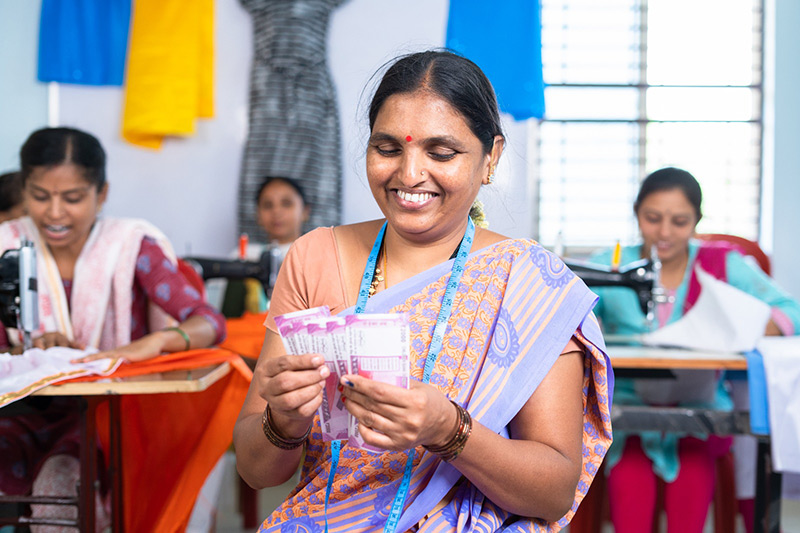
Women today accumulate significantly less wealth than men over their lifetimes. Lower workforce participation, career interruptions, wage gaps and limited financial literacy all contribute to this outcome. Add to that unequal inheritance practices and restricted access to capital, and the gap widens further.
Women today earn undergraduate, master’s and doctoral degrees in significant numbers. Yet they constitute less than onefifth of the urban labour force. Why? The answers are familiar. Women continue to shoulder a disproportionate burden of unpaid labour. But that’s not the only reason – the other significant but lesser discussed reason is that we are conditioned to believe that someone else would always provide. A father. A husband. A son.
But life offers no guarantees. Marriages fail. Businesses collapse. Jobs disappear. Spouses die. Families change. Economic dependence leaves women vulnerable in every one of these situations.
What is optional is seldom pursued with urgency. We do not crave it. We do not fight for it. We do not organise our lives around it. We do not protect it fiercely enough when it is threatened.
Yes, the ecosystem has often failed women. Families do not always share domestic responsibilities equally. Workplaces are not always supportive. But history is also witness to another truth: people rarely get what they are lukewarm about. They get what they desperately want.
For generations, women have been told that earning is desirable but not essential, empowering but not necessary, beneficial but not compulsory. Perhaps that is why financial independence has not become a non-negotiable aspiration for enough women. The day we stop treating it as a choice and start treating it as a necessity, our decisions will change. Families will adapt. Workplaces will respond. Policies will evolve. And society will slowly realign itself around a new reality. As the saying goes, when you want something badly enough, the universe conspires to make it happen. Women must now want financial independence with that same sense of urgency.

The question therefore is not whether women should work. The real question is why any able-bodied adult would voluntarily surrender financial autonomy.
A salary is income. A house in your name is wealth. An investment portfolio is wealth. Inheritance is wealth. A retirement corpus is wealth. Financial independence requires more than earning. It requires ownership.
The conversation must move beyond employment and towards financial sovereignty. Every woman should know how to earn. Every woman should know how to save. Every woman should know how to invest. Every woman should understand inheritance rights. Every woman should own assets. And every family should raise daughters with the same expectation that they raise sons: that adulthood comes with economic responsibility.
The future of women’s empowerment will not be determined by motivational slogans or corporate diversity campaigns alone. It will be determined by whether more women earn income, build assets, accumulate capital and create wealth. Because true empowerment begins when a woman has the ability to make choices. And choices become meaningful only when they are backed by financial independence.
The era of optionality is over. The era of financial sovereignty must begin.